

US says Colombia failing to meet drug war obligations amid record cocaine output

U.S. strikes another alleged Venezuelan drug boat
The United States military struck another alleged drug boat coming from Venezuela, President Trump announced. Trump said the strike killed "3 male terrorists" in the post on Truth Social.
The Trump administration on Monday added Colombia to a U.S. list of nations failing to cooperate in the drug war for the first time in nearly three decades, citing a surge in cocaine production and deteriorating relations with Colombia’s leftist president, Gustavo Petro.
Even as it determined that Colombia had failed to meet its international counternarcotics obligations, the White House issued a sanctions waiver, avoiding cuts to U.S. assistance and citing vital national interests.
Still, the designation represents a sharp rebuke to a traditional U.S. ally and threatens to strain cooperation on security and economic initiatives, analysts say.
Why Colombia is back on the US drug war blacklist
The backstory:
The last time Washington decertified Colombia was in 1997, at the height of cartel power. At the time, drug money and violence had infiltrated the country’s institutions, and then-President Ernesto Samper was accused of receiving campaign contributions from the Cali cartel.
Relations shifted dramatically in the years that followed. Successive U.S. administrations invested billions of dollars to eradicate coca crops, strengthen Colombia’s military, and provide economic alternatives for rural farmers. For years, the strategy was hailed as a rare U.S. foreign policy success in Latin America.
That progress began to unravel after Colombia’s courts halted U.S.-funded aerial spraying of coca crops in the mid-2010s, citing environmental and health concerns. A 2016 peace deal with the Revolutionary Armed Forces of Colombia (FARC) also steered policy away from forced eradication and toward voluntary crop substitution and rural development.
Cocaine production at record levels
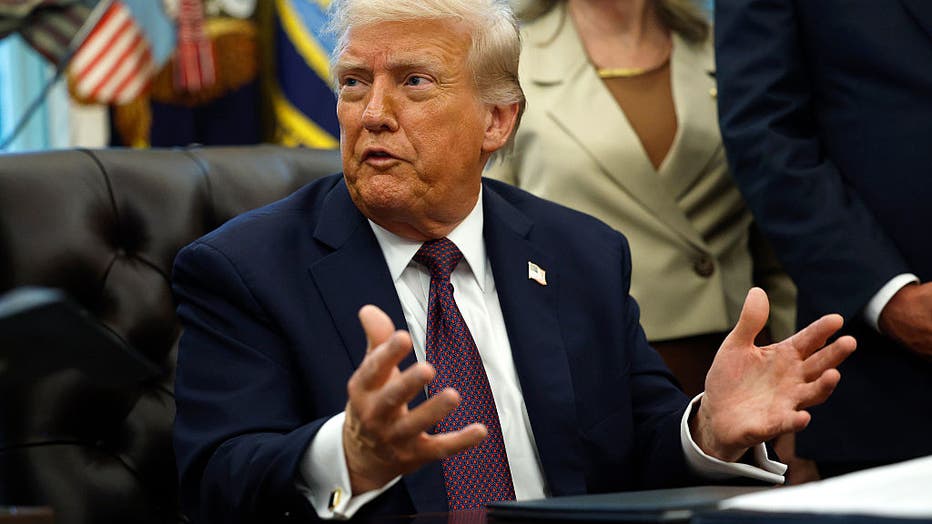
President Donald Trump speaks at the White House in Washington. The Trump administration on Monday added Colombia to a list of nations failing to cooperate in the drug war for the first time in nearly 30 years. (Photo by Kevin Dietsch/Getty Images)
Since the shift, coca cultivation has soared. According to the U.N. Office on Drugs and Crime, land dedicated to coca reached a record 253,000 hectares in 2023 — nearly triple the level of a decade ago. Drug seizures have also risen sharply, with Colombia intercepting 884 metric tons of cocaine last year.
Manual eradication under Petro’s government has slowed significantly. Colombian authorities have removed just over 5,000 hectares of coca plants this year, compared to 68,000 hectares in the final year of Petro’s conservative predecessor’s term.
The other side:
Petro, a former rebel who took office in 2022, has rejected U.S. pressure for tougher eradication measures. He has denied American extradition requests and publicly criticized U.S. drug enforcement efforts, including operations in neighboring Venezuela.
"Under my administration, Colombia does not collaborate in assassinations," Petro said earlier this month after the U.S. military carried out a deadly strike on a Venezuelan vessel Washington said was transporting cocaine.
The Source: This report is based on information from the Associated Press and the Washington Office on Latin America.