

Treasury chief says US could issue refunds if court strikes down Trump tariffs

Trump tariffs declared unlawful by U.S. appeals court
The American Institute for Economic Research's Thomas Savidge joins LiveNOW's Austin Westfall to react to a U.S. appeals court ruling that most of President Donald Trump's sweeping tariffs are illegal.
Treasury Secretary Scott Bessent said Sunday that the Treasury Department will issue rebates if the Supreme Court upholds a ruling finding President Donald Trump’s "reciprocal" tariffs exceeded his authority.
What they're saying:
"We would have to refund roughly half the tariffs, which would be a major blow to the Treasury," Bessent said in an interview on NBC News’ Meet the Press.
He added, "If the court rules that way, we’ll have no choice but to comply."
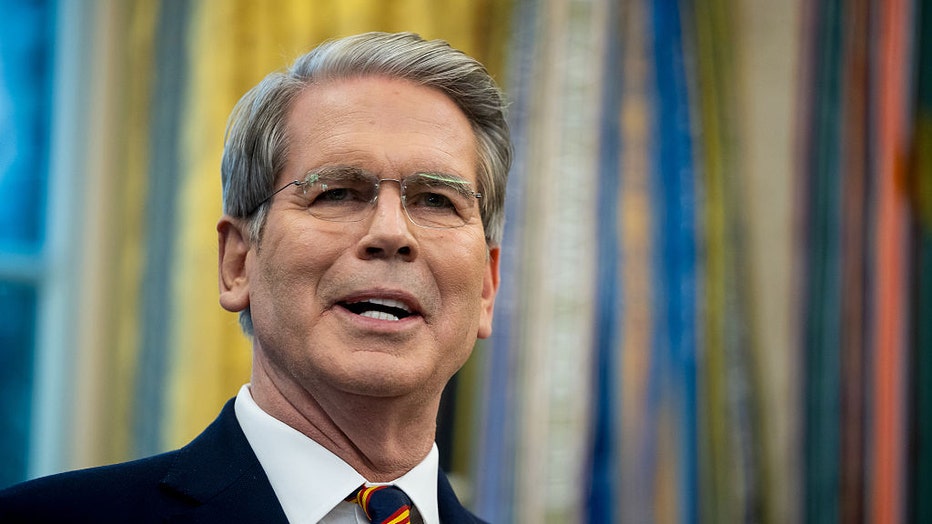
Scott Bessent, US treasury secretary, during an announcement in the Oval Office of the White House in Washington, DC, US, on Friday, Sept. 5, 2025. Photographer: Francis Chung/Politico/Bloomberg via Getty Images
Trump asks SCOTUS to weigh in on tariffs
The backstory:
The Trump administration took the fight over tariffs to the Supreme Court, asking the justices to rule quickly that the president has the power to impose sweeping import taxes under federal law.
The government called on the court to reverse an appeals court ruling that found most of President Donald Trump’s tariffs are an illegal use of an emergency powers law.
The U.S. Court of Appeals for the Federal Circuit left the tariffs in place for now, but the administration nevertheless called on the high court to intervene quickly in a petition filed electronically late Wednesday and provided to The Associated Press. It was expected to be formally docketed on Thursday.

Appeals court strikes President Trump’s tariffs
A U.S. appeals court struck down President Donald Trump's tariffs in an appeals ruling, deeming them illegal under federal law. The court declared that trafficking and reciprocal tariffs exceeded presidential authority under the International Emergency Economic Powers Act.
Solicitor General D. John Sauer asked the justices to take up the case and hear arguments in early November.
But the stakes are also high for small businesses battered by tariffs and uncertainty, said Jeffrey Schwab, senior counsel and director of litigation at the Liberty Justice Center.
"These unlawful tariffs are inflicting serious harm on small businesses and jeopardizing their survival. We hope for a prompt resolution of this case for our clients," he said.
RELATED: Here's who would get refunds if Trump's tariffs get thrown out
The businesses have twice prevailed, once at a federal court focused on trade and again with the appeals court’s 7-4 ruling.
Their lawsuit is one of several challenging the tariffs and erratic rollout that have shaken global markets, alienated U.S. trading partners and allies and raised fears of higher prices and slower economic growth.
But Trump has also used the levies to pressure the European Union, Japan and other countries into accepting new trade deals. Revenue from tariffs totaled $159 billion by late August, more than double what it was at the same point the year before.
Dig deeper:
Most judges on the U.S. Court of Appeals for the Federal Circuit found the 1977 International Emergency Economic Powers Act, or IEEPA, did not let Trump usurp congressional power to set tariffs. The dissenters, though, said the law does allow the president to regulate importation during emergencies without explicit limitations.
The ruling involves two sets of import taxes, both of which Trump justified by declaring a national emergency: the tariffs first announced in April and the ones from February on imports from Canada, China and Mexico.

Trump threatens furniture tariffs in coming months
International trade attorney Michelle Schulz joins LiveNow's Austin Westfall to discuss President Trump's announcement that his administration will be conducting a "major tariff investigation on furniture coming in to the United States" within the next 50 days.
The Constitution gives Congress the power to impose taxes, including tariffs. But over the decades, lawmakers have ceded authority to the president, and Trump has made the most of the power vacuum.
Some Trump tariffs, including levies on foreign steel, aluminum and autos, weren’t covered by the appeals court ruling. It also does not include tariffs Trump imposed on China in his first term that were kept by Democratic President Joe Biden.
Trump can impose tariffs under other laws, but those have more limitations on the speed and severity with which he could act.
The government has argued that if the tariffs are struck down, it might have to refund some of the import taxes that it’s collected, delivering a financial blow to the U.S. Treasury.
The Source: The information in this story comes from multiple sources. Treasury Secretary Scott Bessent’s remarks were made during an interview on NBC News’ "Meet the Press." Details about the Supreme Court case, the government’s petition, and the appeals court ruling were reported by the Associated Press, which obtained and reviewed court filings. This story was reported from Los Angeles.