

Adaptive gaming technology opens new doors for players with disabilities
Adaptive gaming technology opens new doors for players
Video games are a daily escape for billions of people worldwide, offering a chance to compete, explore and connect. But for players with physical disabilities, traditional controllers can make that world difficult or impossible to access.
ORLANDO, Fla. - Video games are a daily escape for billions of people worldwide, offering a chance to compete, explore and connect. But for players with physical disabilities, traditional controllers can make that world difficult or impossible to access.
Health and education leaders in Central Florida are working to change that through a partnership between Orlando Health and Full Sail University, focusing on adaptive gaming technology that doubles as both entertainment and rehabilitation.
What they're saying:
For Adrian Araiz, the barrier was physical. After breaking his back, Araiz lost the ability to fully use his fingers, making traditional video game controllers difficult or impossible to operate.
"I mainly play Apex when I actually want to do more active gameplay. I play a lot of Minecraft," Araiz said.
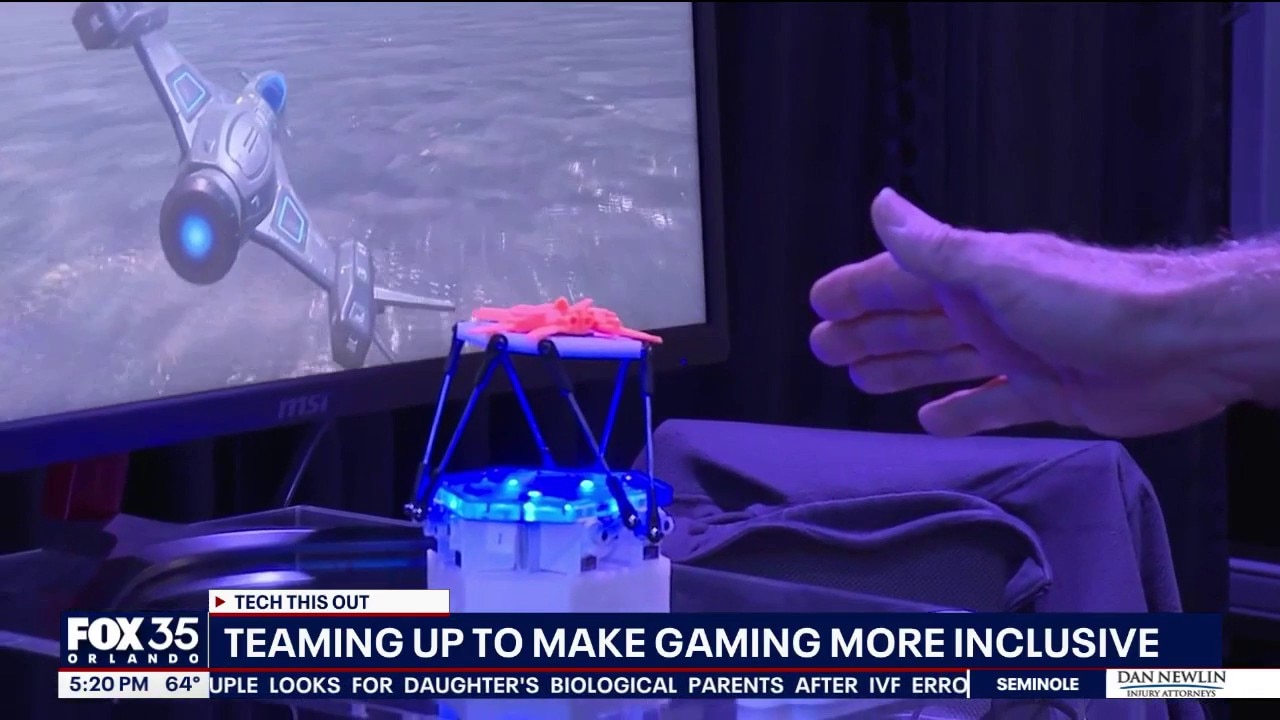
Adaptive gaming technology has helped reopen that world for him. Araiz said he was introduced to specialized equipment that allows players to interact with games in new ways, including devices that can be controlled with limited hand movement or other alternative inputs.
"There’s like a little bionic arm that you can control with your brain," he said. "I didn’t even know that was a thing until I got to talk to the right people."
CLICK TO DOWNLOAD THE FOX LOCAL APP
The technology is part of a collaboration between Orlando Health and Full Sail University, aimed at blending gaming, rehabilitation and innovation. Organizers say the partnership is designed to help patients while also giving students hands-on experience in developing accessible technology.
"It really ties in what Full Sail teaches when it comes to both the educational side and the technological side and combining that with what Orlando Health brings to the table with their next-level health care," said Jacob Kaplan, director of esports business strategy at Full Sail University.
SIGN-UP FOR FOX 35'S BREAKING NEWS, DAILY NEWS NEWSLETTERS
At the Orlando Health Fortress, Full Sail students are receiving scholarships to continue designing adaptive tools that can be used not only in gaming, but in everyday life. Christine Davidson, senior director of ambulatory rehab operations at Orlando Health, said the goal is to expand access well beyond entertainment.
"They’re utilizing what they’ve learned up until this point in order to create something that can help folks that need to be able to use adaptive tech within not just gaming, but everyday activities," Davidson said.
For Araiz, the impact is personal and immediate.
"I’m just very happy there’s different technology out there now that I can utilize, or people in wheelchairs can utilize," he said.
Advocates say the effort proves that in adaptive gaming, there is no "game over" — only new ways to play.
The Source: This story was written based on information shared by Orlando Health and Full Sail University, including interviews with gamer Adrian Araiz, Director of Esports Business Strategy at Full Sail University, Jacob Kaplan, and Christine Davidson, the Senior Director of Ambulatory Rehab Operations at Orlando Health.