

The storm that took down the Edmund Fitzgerald

The legend of the Edmund Fitzgerald lives on
The mystery behind the sinking of the Edmund Fitzgerald on Lake Superior is still very much alive, 50 years later. In this LiveNOW & Then full episode, we look back at the Great Lakes' most infamous shipwreck, and how it's been studied and memorialized over the decades.
DETROIT - On Nov. 10, 1975, the SS Edmund Fitzgerald sank during a massive storm on Lake Superior.
It was one of the most devastating shipwrecks in recorded U.S. history.
Take a look back at what happened on that tragic day.
Where was the Edmund Fitzgerald headed?
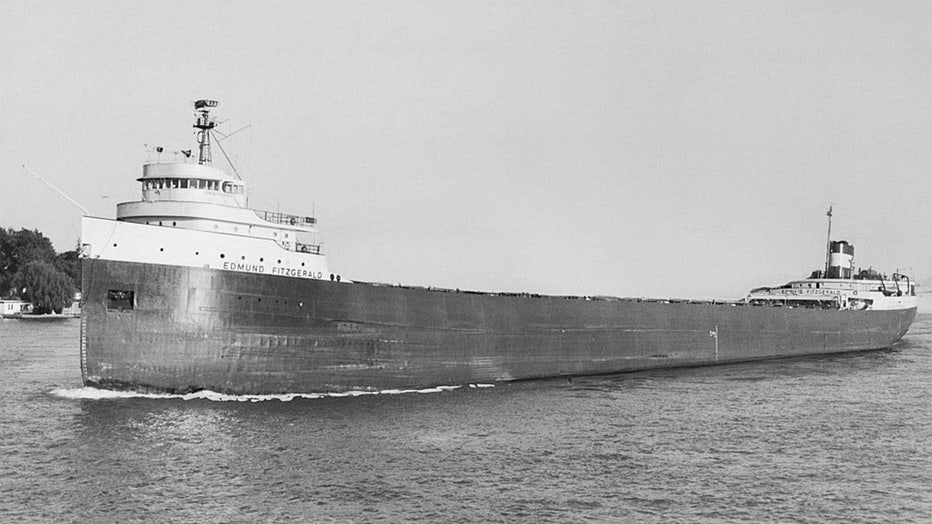
FILE - View of the 729-foot ore boat SS Edmund Fitzgerald, Sault Sainte Marie, Michigan, 1972. The ship sank, losing all hands, over the night of Nov. 10, 1975. (Photo by Bettmann/Getty Images)
Timeline:
The ship's voyage has been well documented through the years.
Nov. 9, 1975, 2:15 p.m. The Edmund Fitzgerald departs Superior, Wisconsin, en route to Detroit.
Nov. 9, 5 p.m. The ship is joined by the Arthur M. Anderson. The National Weather Service issues gale warnings for Lake Superior that forecast winds up to 40 knots and waves of 5 to 10 feet.
Nov. 10, after 2 a.m. Because of the storm, the two ships head northeast, out of the normal shipping lanes. NWS issues a storm warning for northeast winds up to 50 knots and 8-to-15-foot waves.
Nov. 10, 1 p.m. Edmund Fitzgerald turns southeast toward Whitefish Bay, with the Anderson several miles behind. A weather station at Stannard Rock reports winds at 50 knots gusting to 59 knots.
Nov. 10, 3:30-3:35 p.m. The Edmund Fitzgerald calls Anderson to report damage: a fence rail down, two ballast tank vents lost or damaged, the ship listing. It reduces speed so Anderson can stay close. Shortly after, the Coast Guard advises that the Sault Ste. Marie locks have closed and ships should seek a safe anchorage.
Nov. 10, 4:10-4:15 p.m. The Edmund Fitzgerald reports both its radars have failed and asks Anderson to help with navigation. A radio beacon at Whitefish Point has been knocked out by a power failure, further complicating navigation. NWS predicts northwest winds of 38 to 52 knots with gusts to 60 knots and waves of 8 to 16 feet.
Nov. 10, 5-5:30 p.m. McSorley tells the captain of a Swedish vessel that the Edmund Fitzgerald has a "bad list," has lost both radars and is taking waves over the deck, describing the seas as some of the worst McSorley has ever been in.

Exploring the Edmund Fitzgerald's Legacy 50 years later
Explore the life and legacy of the most famous ship to sail the Great Lakes, from its launch to its disappearance on a cold November evening in 1975. FOX 2 dives into the night it sank, the theories behind its disappearance, and the mark it left on the region 50 years late
How many people died on the Edmund Fitzgerald?
All 29 men who were aboard the ship died.
The crew members were:
- Michael E. Armagost, 37
- Fred J. Beetcher, 56
- Thomas D. Bentsen, 23
- Edward F. Bindon, 47
- Thomas D. Borgeson, 41
- Oliver J. Champeau, 41
- Nolan S. Church, 55
- Ransom E. Cundy, 53
- Thomas E. Edwards, 50
- Russell G. Haskell, 40
- George J. Holl, 60
- Bruce L. Hudson, 22
- Allen G. Kalmon, 43
- Gordon F. MacLellan, 30
- Joseph W. Mazes, 57
- John H. McCarthy, 62
- Ernest W. McSorley, 63 (Captain)
- Eugene W. O’Brien, 50
- Karl A. Peckol, 20
- John J. Poviach, 59
- James A. Pratt, 44
- Robert C. Rafferty, 62
- Paul M. Riippa, 22
- John D. Simmons, 62
- William J. Spengler, 59
- Mark A. Thomas, 21
- Ralph G. Walton, 58
- David E. Weiss, 22
- Blaine H. Wilhelm, 52
Gales of November: Diving the Edmund Fitzgerald
In this news documentary, you will hear from the few people who have seen the Edmund Fitzgerald since the ship sank in Lake Superior 50 years ago. As historians and experts continue to debate why the ship sank, the answers could still be found in the wreckage…but there likely will never be another dive.
Great Lakes’ unique weather conditions
Local perspective:
The Great Lakes are vast and could be considered oceans. For example, Lake Superior measures about 350 miles wide.
What’s even more astonishing is that storms that take place over the Great Lakes can be worse than storms over oceans, according to Derek Kevra, meteorologist for FOX 2 Detroit.
Dig deeper:
High winds over the Great Lakes can produce waves that are more frequent than those in oceans.
That doesn’t necessarily mean they are stronger, but they occur more often and are larger, Kevra explained.
"Well, over the ocean, you get a huge wave that comes through, then you get break, then you another huge wave that comes though. But over the Great Lakes, you don't get those breaks. And that's likely one of the things that happened with the Edmund Fitzgerald is there was multiple waves, intense waves, very quickly," Kerva continued.
Gales of November: Final Voyage of the Edmund Fitzgerald
To commemorate 50 years since the sinking of the Edmund Fitzgerald, FOX6 has produced this hour-long documentary that explores the important role ‘The Fitz’ and her crew played in the history of Great Lakes shipping as well as the ripple effect her sinking had on the industry.
The backstory:
The storm that brought down the Edmund Fitzgerald was not unusual for its time. November is a busy month for inclement weather on the Great Lakes and there's a reason why.
The arrival of colder, darker months means the air temperature blowing into the region arrives with a chill. But not the water, which is still warm from the summer. This clash of cold air and warm water fuels an unstable weather system.
The result? Hurricane-force winds and waves that can reach three stories high, known as the Gales of November.
On Nov. 10, 1975, the 29 sailors aboard the Edmund Fitzgerald got caught in one of these weather patterns, and disappeared while embroiled in the heart of the storm.
What they're saying:
"They were expecting initially 40- to 45-, 50-mile-an-hour winds when they issued a gale warning, and then they upgraded it to a storm warning expecting higher ends of 50 to maybe 60, but 100 miles an hour was not expected. And so that is one of the things that we know now, a system like this could produce a high end of 100-mile-an-hour wind gusts. Kind of right in line with the category one hurricane," Kevra said.
The Source: Information for this article was taken from an interview with FOX 2 Detroit’s Derek Kevra and previous reporting by FOX 2, Detroit Free Press, and The Associated Press. This story was reported from San Jose.