

New federal dietary guidelines: Avoid processed foods, added sugar

New dietary guidelines for Americans released
Federal health officials released the 2025-2030 U.S. Dietary Guidelines for Americans, saying Americans should eat more whole foods and protein, fewer highly processed foods and less added sugar.
The Trump administration released new nutritional guidelines Tuesday.
Here’s what’s in the 2025-2030 U.S. Dietary Guidelines for Americans, issued by Health Secretary Robert F. Kennedy Jr. and Agriculture Secretary Brooke Rollins:
Dietary Guidelines for Americans
The backstory:
The dietary guidelines, which provide a template for a healthy diet, are required by law to be updated every five years.
But in a country where more than half of adults have a diet-related chronic disease, few Americans actually follow the guidance, research shows.
Big picture view:
The new guidelines for healthy eating say Americans should eat more whole foods and protein, fewer highly processed foods and less added sugar.
Dig deeper:
The guidance will have the most profound effect on the federally funded National School Lunch Program, which is required to follow the guidelines to feed nearly 30 million U.S. children on a typical school day.
By the numbers:
The new document is just 10 pages, upholding Kennedy's pledge to create a simple, understandable guideline. Previous editions of the dietary guidelines have grown over the years, from a 19-page pamphlet in 1980 to the 164-page document issued in 2020, which included a four-page executive summary.

Secretary of Health and Human Services Robert F. Kennedy Jr. speaks during the daily briefing in the Brady Briefing Room of the White House in Washington, DC, on January 7, 2026. Also pictured, L/R, FDA Commissioner Marty Makary, Medicare and Medicai
What they're saying:
"Our message is clear: Eat real food," Kennedy told reporters at a White House briefing.
"We are finally putting real food back at the center of the American diet," Rollins added.
Dietary guidelines new pyramid
Big picture view:
The Trump administration released a "new pyramid" emphasizing protein and vegetables.
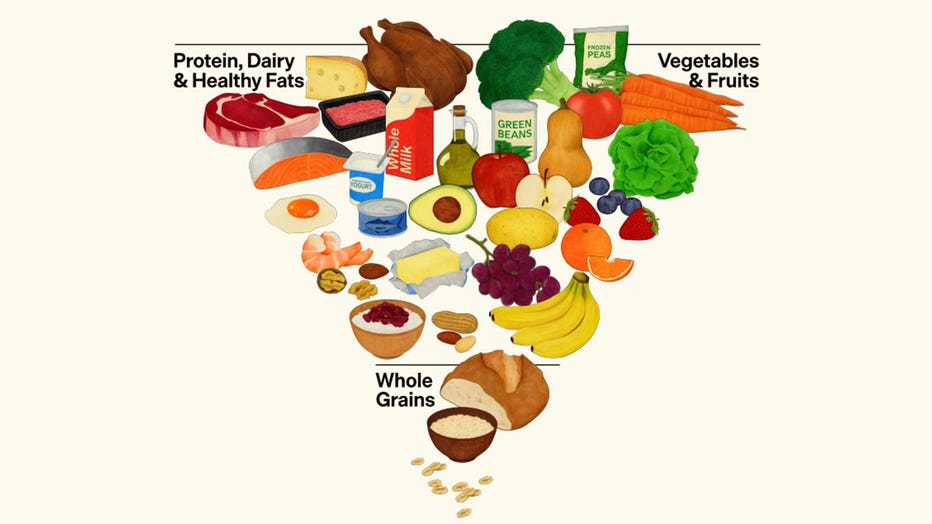
Image: Dietary Guidelines for Americans, Department of Health & Human Services
What they're saying:
"It’s a simple guide designed to help Americans eat real, whole foods more consistently," the administration says. "It prioritizes nutrient-dense foods and reduces reliance on highly processed products, using modern nutrition science to support everyday health."
New guidelines on saturated fat
Big picture view:
The new guidance backs away from revoking long-standing advice to limit saturated fats, despite signals from Kennedy and Food and Drug Commissioner Marty Makary that the administration would push for more consumption of animal fats to end the "war" on saturated fats.
Instead, the document suggests that Americans should choose whole-food sources of saturated fat — such as meat, whole-fat dairy or avocados — while continuing to limit saturated fat consumption to no more than 10% of daily calories. The guidance says "other options can include butter or beef tallow," despite previous recommendations to avoid those fats.
What they're saying:
"In this new guidance, we are telling young people, kids, schools - you don’t need to tiptoe around fat and dairy. You don’t need to push low fat milk to kids. And we are maintaining the 10% of calories as saturated fat in guidance," Makary said.
New guidelines on alcohol
Big picture view:
The guidelines advise consuming less alcohol for better overall health.
What they're saying:
Dr. Mehmet Oz, the Administrator for the Centers for Medicare & Medicaid Services, said in the briefing that alcohol can offer social connectedness, but that overall it is healthier to abstain.
"In the best case scenario, I don’t think you should drink alcohol. But it does allow people an excuse to bond and socialize, and they’re probably nothing healthier than having a good time with friends in a safe way," he said. "In general, move away from (the guidelines saying) two glasses for men and one glass for women - there was really never good data to support that quantity of alcohol consumption. That data was probably primarily confused with broader data about social connectedness."
The Source: Information in this article was taken from a Jan. 7, 2026, White House briefing and a DHHS press release. This story was reported from Detroit.