

New Florida license plate law: What's OK and not OK?

Florida police clarify new law on covered or altered license plates
Florida law enforcement agencies are reminding drivers that a new state law makes it illegal to cover, hide, or alter a license plate — a rule that has sparked widespread confusion on social media.
After a new Florida law – banning anything that blocks or alters a vehicle's driver's license plate – went into effect, officials are clearing up what license plate frames would lead to fines or jail time.
A Florida statue said anything preventing the ability to record the primary features or details of a license plate – including the numbers or validation sticker – is subject to a second-degree misdemeanor.
The backstory:
The law was signed by Florida Gov. Ron DeSantis on May 19 and went into effect on Oct. 1.
The Casselberry Police Department said this law is about enforcing people who are trying obscure tags and using devices to hide their plate or flip their plate.
This law helps law enforcement catch hit-and-run drivers, prevent toll violations, combat fraud and vehicle theft and to make sure automated systems can read license plates properly, the department said.
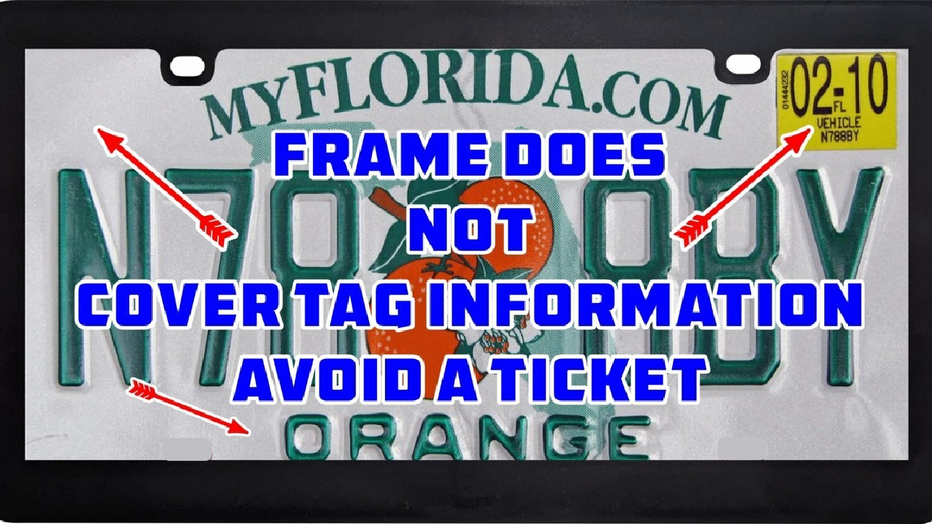
Police show a license plate that is permitted under a new 2025 Florida statute. (Source: Casselberry Police Department)
What license plate frames are permitted?
To avoid a fine, the license plate number and registration sticker must be in clear view. Frames surrounding the information on the license plate are permitted.
"We will not be arresting people just for having a basic, simple plate frame," Casselberry Police said in a Facebook statement. "Our focus is on intentional alterations, blocked characters, and unreadable plates or decals. It is possible to have cosmetic accessories that stay within the law."
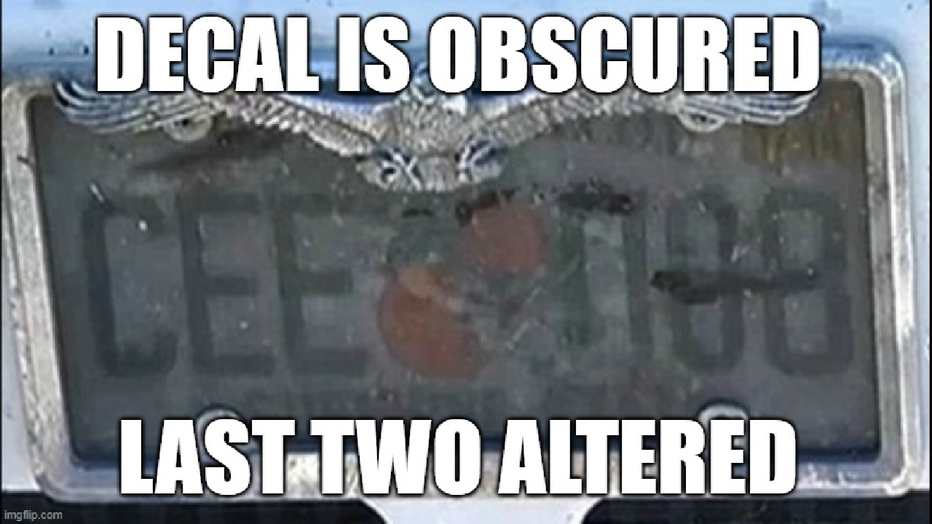
This license plate is an example in which a driver will face fines or jail time under Florida 2025 license plate obscurement statute. (Source: Casselberry Police Department)
What license plate frames aren't allowed?
License plate information must be visible at all times. If a license plate frame covers a small section of the plate's numbers, letters or decal, it can lead to a traffic stop or violation.
No coverings, sprays, tints, wraps or frames that block any part of information will be allowed.
Florida Department of Highway Safety and Motor Vehicles clears up questions
The Florida Department of Highway Safety and Motor Vehicles sent a memo to all law enforcement agencies last week with guidance on how the rules should be enforced.
The law, which took effect Oct. 1, prohibits the use of license plate obscuring devices. It bans anything that covers, obscures or interferes with "the legibility, angular visibility, or detectability of the primary features or details, including the license plate number or validation sticker, on the license plate."
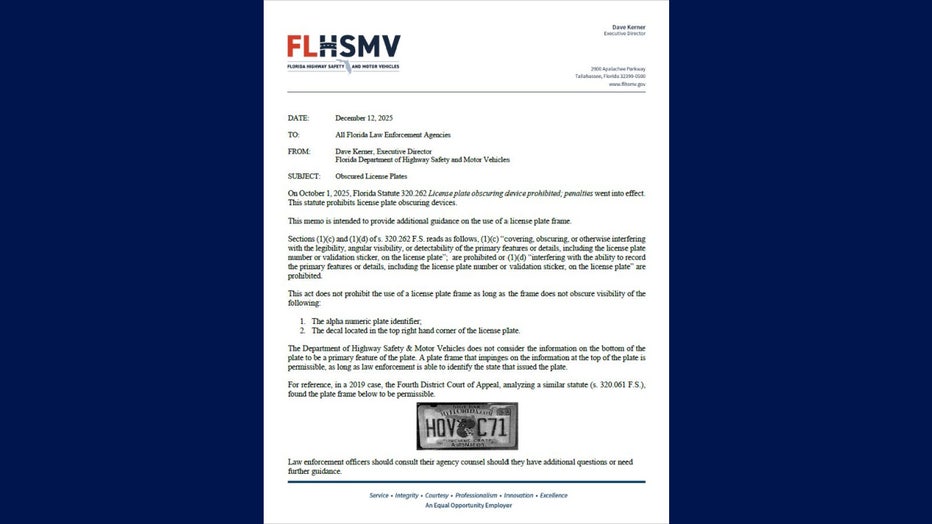
The Florida Department of Highway Safety and Motor Vehicles issued a new memo to help clarify the new law about Florida license plate frames. (Courtesy: FLHSMV)
So, license plate frames aren't completely banned. Frames are allowed as long as they don’t cover the plate number or the registration sticker in the top right corner, according to state officials.
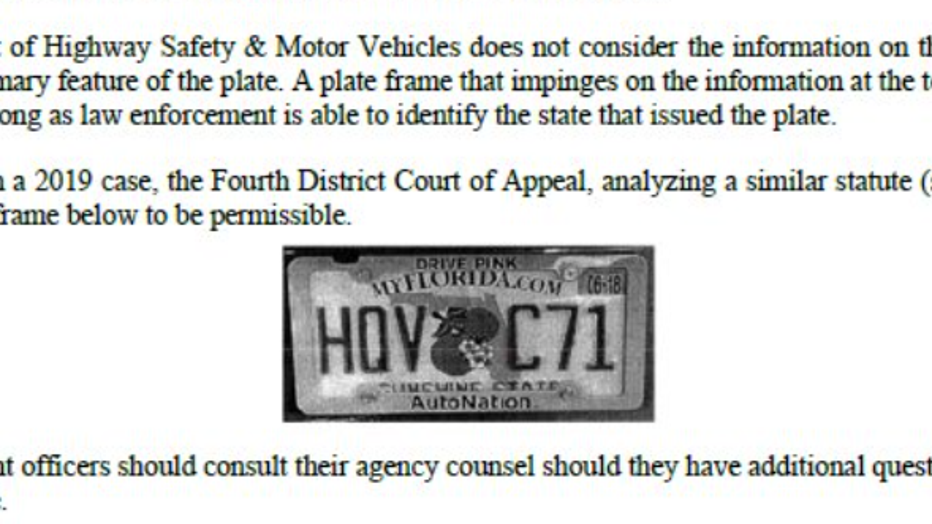
Frames that cover the information at the bottom of the plate are also OK, according to the state, and they can also partially cover the state name at the top of the plates as long as law enforcement can still identify the state that issued the plate.
"The Department of Highway Safety & Motor Vehicles does not consider the information on the bottom of the plate to be a primary feature of the plate," the state said in the memo.
The memo also included a photo of a license plate frame that is considered OK. The frame partially covers the "Sunshine State" lettering at the bottom of the plate and the lettering at the top. But the license plate number and the registration decal are clearly visible and not obscured.
Law enforcement agencies have said that the law is designed to target tinted covers and devices that completely obscure or hide plates from law enforcement and cameras.
The law adds harsher penalties for anything that obstructs plates, making alterations to license plates a second-degree misdemeanor rather than a traffic violation.
What does the Florida license plate statute say?
2025 Florida statute 320.061: Unlawful to alter motor vehicle registration certificates, license plates, temporary license plates, mobile home stickers, or validation stickers or to obscure license plates; penalty, says:
A person may not alter the original appearance of a vehicle registration certificate, license plate, temporary license plate, mobile home sticker, or validation sticker issued for and assigned to a motor vehicle or mobile home, whether by mutilation, alteration, defacement, or change of color or in any other manner. A person may not apply or attach a substance, reflective matter, illuminated device, spray, coating, covering, or other material onto or around any license plate which interferes with the legibility, angular visibility, or detectability of any feature or detail on the license plate or interferes with the ability to record any feature or detail on the license plate. A person who knowingly violates this section commits a misdemeanor of the second degree, punishable as provided in s. 775.082 or s. 775.083.
How much is the fine for obscured license plates?
According to the Ocoee Police Department, drivers found violating this law can face a second-degree misdemeanor, which carries a penalty of up to a $500 fine and up to 60 days in jail.
The Source: Information in this story was gathered from the Casselberry, Seminole County and Ocoee Police Department as well as the Florida Department of Highway Safety and Motor Vehicles and 2025 Florida statute 320.061.