

NASA, SpaceX launch supplies, equipment, science experiments to ISS

Watch: Liftoff! NASA, SpaceX launches supplies to ISS
NASA and SpaceX launched 6,500 pounds of supplies and equipment to the International Space Station. This launch provided current astronauts onboard the ISS with scientific investigations, supplies and equipment. On its return trip, the spacecraft will transport items back to Earth for research and repairs.
CAPE CANAVERAL SPACE FORCE STATION, Fla. - NASA and SpaceX launched 6,500 pounds of supplies and equipment to the International Space Station.
This launch provided current astronauts onboard the ISS with scientific investigations, supplies and equipment. On its return trip, the spacecraft will transport items back to Earth for research and repairs.
About the mission: CRS-34
What we know:
The companies' 34th Commercial Resupply Services launch will commence from Launch Complex 40 at Cape Canaveral Space Force Station on Florida's Space Coast.
Watch: Full mission
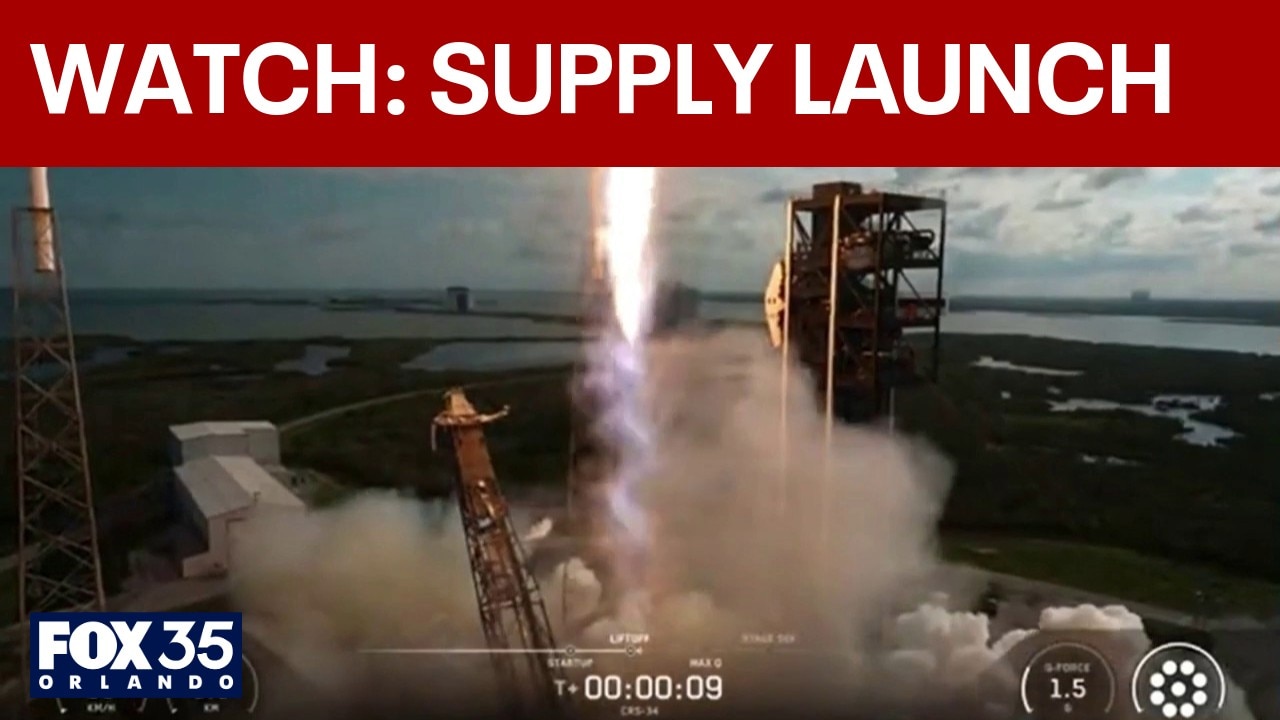
NASA, SpaceX launches supply mission to ISS | FULL
FULL | Watch a full look at the Falcon-9, Dragon Spacecraft launch from Cape Canaveral Space Force Station in Florida on May 15, 2026. The Dragon is carrying 6,500 pounds of supplies and is expected to dock at 7 a.m., May 17.
The CRS-34 mission will launch with the Falcon-9 rocket and Dragon Spacecraft – both owned, designed and operated by SpaceX. This is the sixth flight for both Falcon-9 and the Dragon Spacecraft, NASA said.
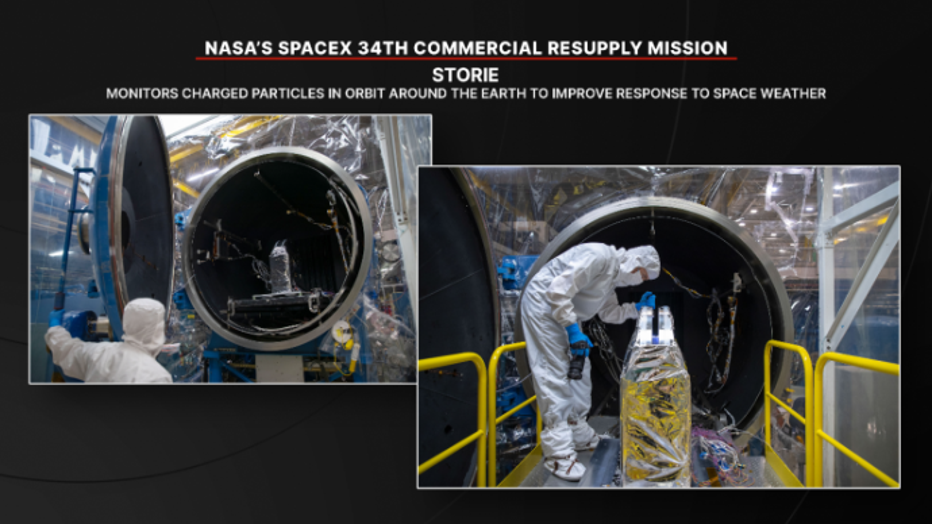
NASA’s SpaceX 34th Commercial Resupply Mission Overview. (Credit: NASA).
SpaceX's Dragon Spacecraft will be loaded with about 6,500 pounds of supplies and new scientific experiments including:
- ODYSSEY, which will evaluate how well Earth-based microgravity simulators recreate space conditions
- STORIE, which monitors charged particles in orbit around the Earth
- Laplace, which studies the movement and collision of dust particles in microgravity to understand particle motion in space
- Green Bone, which observes how bone cells grow and develop in space on a bone scaffold made from wood
- Spark, which evaluates how red blood cells and the spleen change in space for future astronauts.
Dragon will dock at the forward port of the space station's Harmony module.
Due to unfavorable weather, now targeting tomorrow, May 13, for Falcon 9’s launch of the CRS-34 mission to the @Space_Station → https://t.co/c8cVFXwJY0
— SpaceX (@SpaceX) May 12, 2026
Watch: Scrubbed launch
Launch scrubbed: When is the next attempt?
After being postponed twice, due to unfavorable weather, a launch was successful at 6:05 p.m. on Friday, May 15.
What's next:
Dragon will return in mid-June and is set to bring back with it an ocular imaging device used to monitor crew eye health, a sorbent bed that filters trace contaminants from cabin air and a separator pump from the Waste and Hygiene Compartment, NASA said.
Additional items returning include the Advanced Plant Habitat – which supports long-duration plant biology studies – and a pressure management device that recovers vestibule air during depressurization, NASA said.
The plant habitat will be placed on display at a museum, while the pressure management device is being sent back to Earth for repairs and storage as a ground spare, the space agency said.
The Source: Information in this story was gathered from NASA and SpaceX.