

Trump’s birthright citizenship restrictions blocked by judge in third ruling since Supreme Court decision

Trump's birthright citizenship order blocked again
A federal judge blocked the Trump administration from ending birthright citizenship for the children of parents who are in the U.S. illegally on Friday. It's the third court ruling blocking the birthright order nationwide since the Supreme Court decision in June.
WASHINGTON - A federal judge on Friday blocked the Trump administration from ending birthright citizenship for the children of parents who are in the U.S. illegally – the third court ruling blocking the birthright order nationwide since a key Supreme Court decision in June.
U.S. District Judge Leo Sorokin, joining another district court as well as an appellate panel of judges, found that a nationwide injunction granted to more than a dozen states remains in force under an exception to the Supreme Court ruling. That decision restricted the power of lower-court judges to issue nationwide injunctions.
Lawyers for the government had argued Sorokin should narrow the reach of his earlier ruling granting a preliminary injunction, arguing it should be "tailored to the States’ purported financial injuries."
What they're saying:
"The record does not support a finding that any narrower option would feasibly and adequately protect the plaintiffs from the injuries they have shown they are likely to suffer," Sorokin wrote.
Sorokin acknowledged his order would not be the last word on birthright citizenship. Trump and his administration "are entitled to pursue their interpretation of the Fourteenth Amendment, and no doubt the Supreme Court will ultimately settle the question," Sorokin wrote. "But in the meantime, for purposes of this lawsuit at this juncture, the Executive Order is unconstitutional."
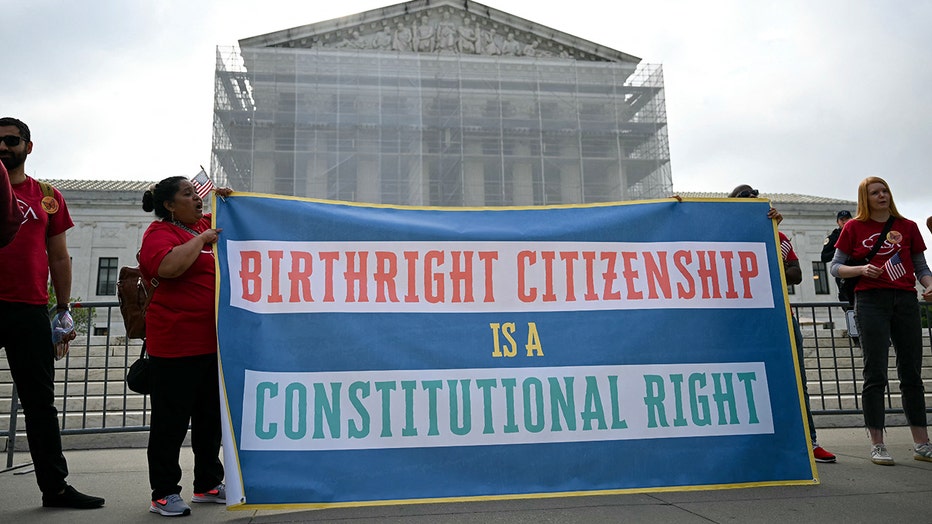
People hold a sign as they participate in a protest outside the US Supreme Court over President Donald Trump's move to end birthright citizenship on March 13. (Credit: Drew ANGERER / AFP via Getty Images)
What is birthright citizenship and what did Trump try to do?
The backstory:
Trump’s executive order sought to deny automatic citizenship to children born in the United States to noncitizen parents. This right, known as birthright citizenship, is based on the 14th Amendment of the U.S. Constitution, which declares that all people born or naturalized in the country are citizens.
Trump had long criticized the policy as a "magnet" for illegal immigration and argued he could end it via executive authority. Legal scholars widely rejected that claim, saying only Congress—or a constitutional amendment—could change that right.
What's next:
The case is likely to reach the U.S. Supreme Court, where justices may be asked to resolve both the constitutional question and whether lower courts can continue issuing sweeping nationwide blocks.
At least nine other lawsuits challenging Trump’s order have been filed in different states. The Supreme Court’s eventual decision could redefine the scope of presidential power over immigration and how courts handle constitutional protections.
The Source: This story was reported from Los Angeles. The Associated Press, previous FOX Local reporting contributed.