

Starship lifts off from South Texas on first attempt to circle Earth six times
BOCA CHICA, Texas - SpaceX launched its enormous Starship toward orbit for the first time on Monday, aiming for six full laps around Earth in a crucial test to prove the mega-rocket's readiness for NASA's Artemis moon program.
SpaceX launch
Founder Elon Musk's showpiece rocket — the biggest and most powerful ever built — lifted off carrying 26 of the latest and most advanced Starlink satellites to join the thousands of older models already providing internet service.
The launch marked Starship's 14th full-scale test flight from SpaceX's facility at the southern tip of Texas over the past three years. Unlike previous flights that ventured only as far as the Indian Ocean, this mission was designed to circle the globe six times from an altitude of 170 miles (275 kilometers) over a span of nearly 10 hours, concluding with a planned splashdown in the Pacific Ocean near Chile.
The first-stage booster was not scheduled to return to the Starbase launch site, instead dropping into the Gulf of Mexico minutes after liftoff.
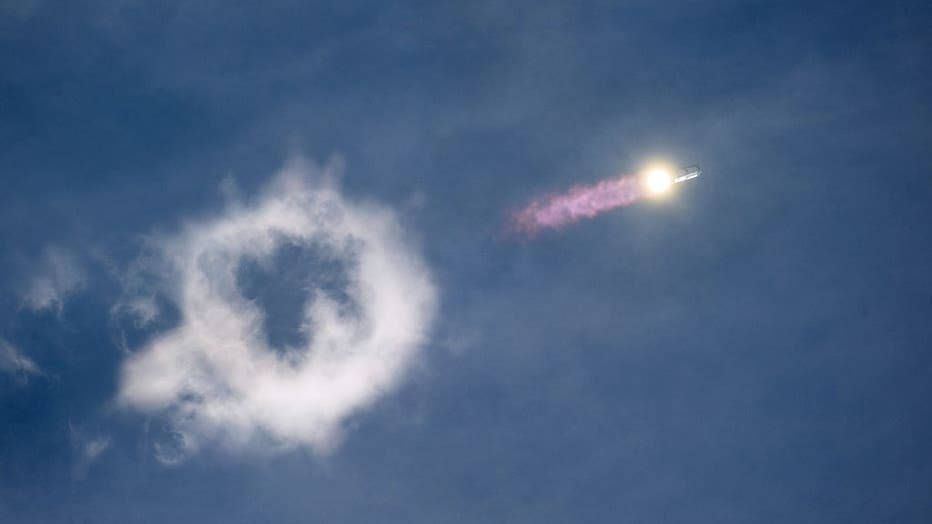
BOCA CHICA BEACH, TEXAS - SEPTEMBER 28: SpaceX Starship Flight 14 launches from its launch pad at Boca Chica Beach on September 28, 2026 in Boca Chica Beach, Texas. The first-ever orbital launch attempt's objective for Flight 14 is to deliver Starlin
Dig deeper:
SpaceX has been pressing hard to certify Starship for orbital flight as a vital step toward future moon and Mars travel. NASA's Artemis III mission is slated as soon as next summer, featuring a complex orbital docking exercise between an Orion capsule and lunar landers from both SpaceX and Jeff Bezos' Blue Moon. Subsequent missions, including Artemis IV currently targeted for no sooner than 2028, will see astronauts land on the moon using whichever billionaire's lander is ready first.
Musk originally developed Starship to eventually carry settlers to Mars, but near-term plans focus on utilizing the fully reusable, 407-foot (124-meter) vehicle to haul massive payloads of satellites into orbit, eventually phasing out the company's Falcon 9 rockets.
The Source: Information in this article is from SpaceX.