

NHC tracking tropical wave in Bay of Campeche; no Florida threat
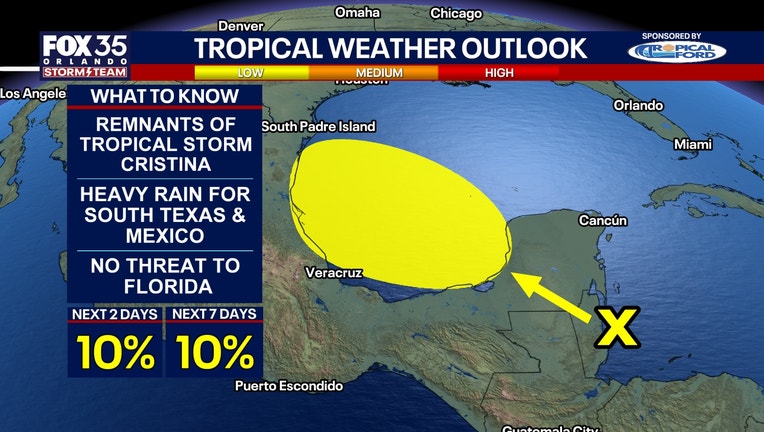
The National Hurricane Center has flagged an area of interest in the Bay of Campeche, near Mexico, for potential tropical development. The chances of development are low – and there is no threat to Florida.
What we know:
A westward-moving tropical wave over Mexico's Yucantan Peninsula is expected to move over the Bay of Campeche as early as Friday, where environmental conditions are "marginally conducive" for tropical development.
Currently, the NHC has given it a low – or 10% chance – of development over the next 7 days.
This area of low pressure is related to the remnants of Tropical Storm Cristina in the Pacific Ocean, which weakened to a weak trough of low pressure near the Coast of Salvador on Thursday.
That system is expected to cross Central America into the Gulf, and then move inland over eastern Mexico late Saturday or Sunday.
2026 Atlantic Hurricane Season
The Atlantic hurricane season runs June 1 - November 30. The most active months are typically between August, September, and October. The Atlantic season actually has two peaks: mid-September and mid-October, though activity tends to drop quickly after the second peak.
Tracking The Tropics: 2026 Hurricane Season Preview
One storm is all it takes. The FOX 35 Storm Team is getting you ready for the 2026 Atlantic hurricane season. We go beyond the headlines to explain this year’s below-average predictions, the debut of the National Hurricane Center's new inland forecast cone, and the AI technology revolutionizing how we track landfalls. Whether you’re a lifelong Floridian or new to the coast, learn exactly what to expect and how to protect your family, pets, and home. Watch the full special.
El Nino and hurricane season
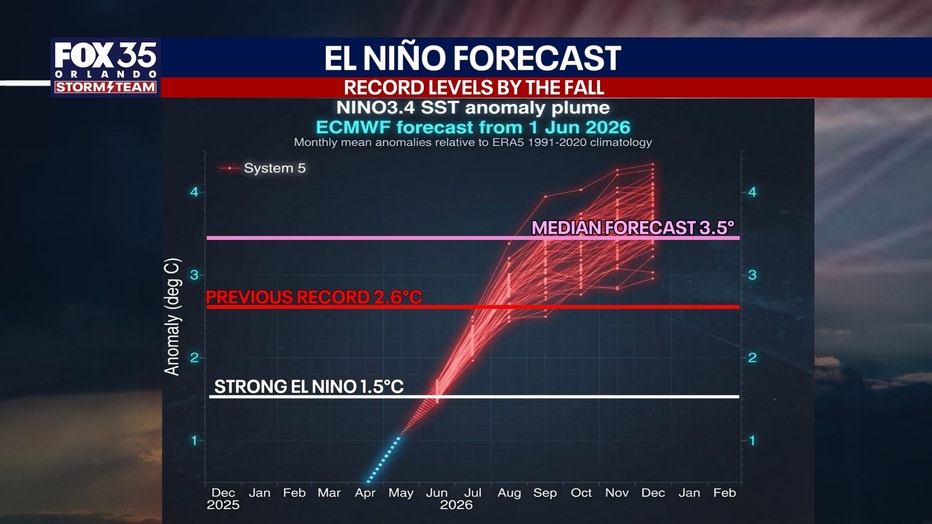
Both NOAA and Colorado State University have released their tropical outlooks for the 2026 hurricane season, predicting a below-average season largely due to El Nino.
On Thursday, the National Weather Service Climate Prediction Center issued an El Eino Advisory, declaring that El Niño conditions had arrived in the Northern Hemisphere, and were expected to strengthen.
By the numbers:
- Average hurricane season: 15 named storms, 7 hurricanes, 3 major hurricanes
- Colorado State University (June 10): 11 named storms, 5 hurricanes, 2 major hurricanes
- NOAA: 8-14 named storms, 3-6 hurricanes, 1-3 major hurricanes.
What is El Niño?
El Niño is the warm phase of a natural climate pattern called ENSO, short for El Niño Southern Oscillation.
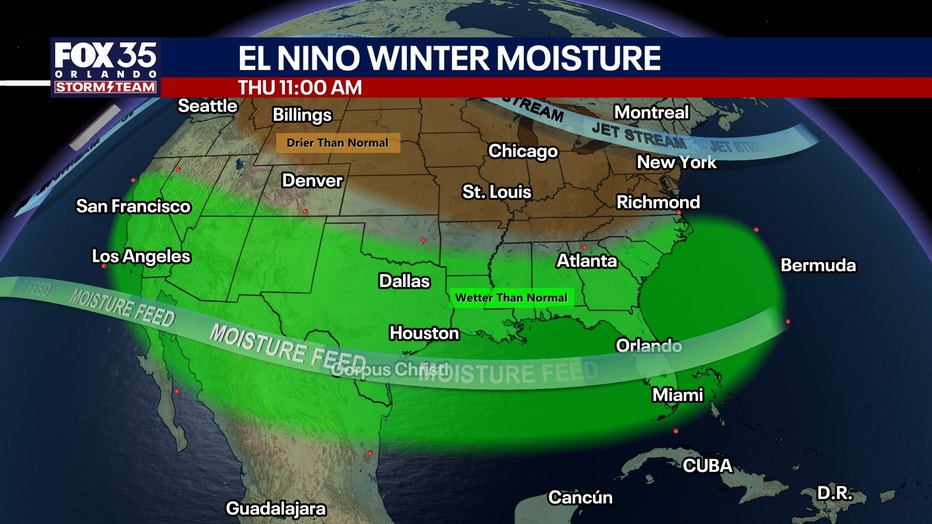
During El Niño, ocean temperatures in the central and eastern equatorial Pacific Ocean become warmer than average by at least 0.5°C above normal. That warming can change the placement and strength of jet streams, storm tracks, rainfall patterns, and temperature patterns across different parts of the world.
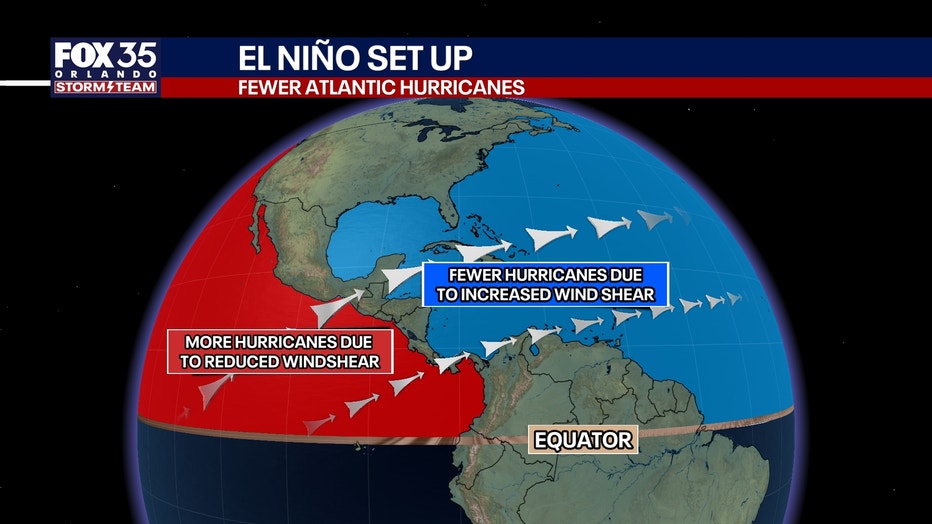
El Niño usually develops every 2 to 7 years. Its effects are often weakest during the spring and summer and become more noticeable during late fall, winter, and early spring.
How does El Niño impact the hurricane season?
El Niño plays an important role during the Atlantic hurricane season, usually making it quieter. That's because during El Niño years, stronger upper level winds develop across the Caribbean and tropical Atlantic, which makes it harder for tropical systems to form and organize.
While that works against tropical activity, it does not mean zero tropical activity. It only takes one tropical storm or hurricane to wreak havoc on a community.
2026 tropical storm names
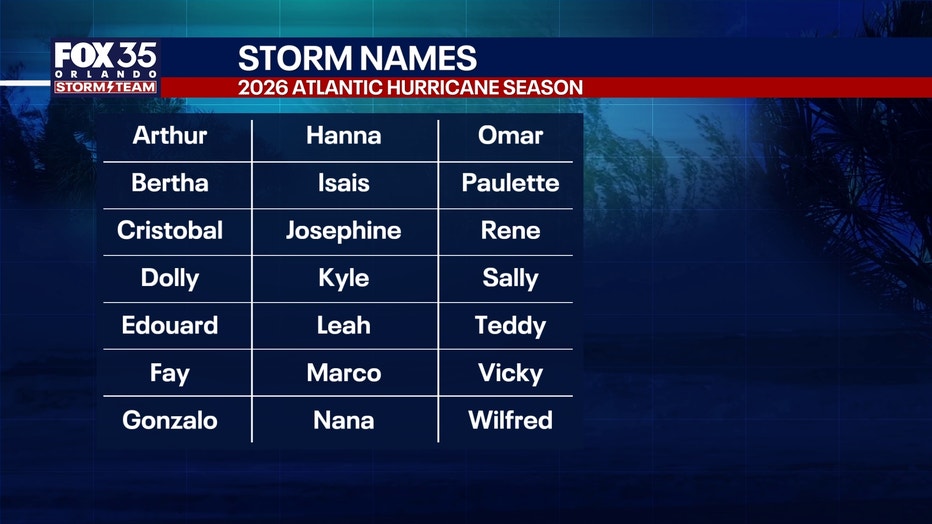
Here are this year's storm names:
- Arthur
- Bertha
- Cristobal
- Dolly
- Edouard
- Fay
- Gonzalo
- Hanna
- Isaias
- Josephine
- Kyle
- Leah
- Marco
- Nana
- Omar
- Paulette
- Rene
- Sally
- Teddy
- Vicky
- Wilfred
If all 21 names are used in a season, there is a reserve list with an additional 21 names.
The Source: The information used in this article is from the National Hurricane Center, National Weather Service, Climate Prediction Center, and FOX 35 Storm Team.