

NASA outlines 10-day flight plan for historic Artemis II lunar mission

NASA prepares to roll Artemis II moon rocket to launch pad
NASA is preparing to take a major step toward its next crewed mission to the moon as the Artemis II rocket is set to roll out to the launch pad at Kennedy Space Center.
MERRIT ISLAND, Fla. - NASA prepares to launch its first crewed mission around the moon under the agency's Artemis program.
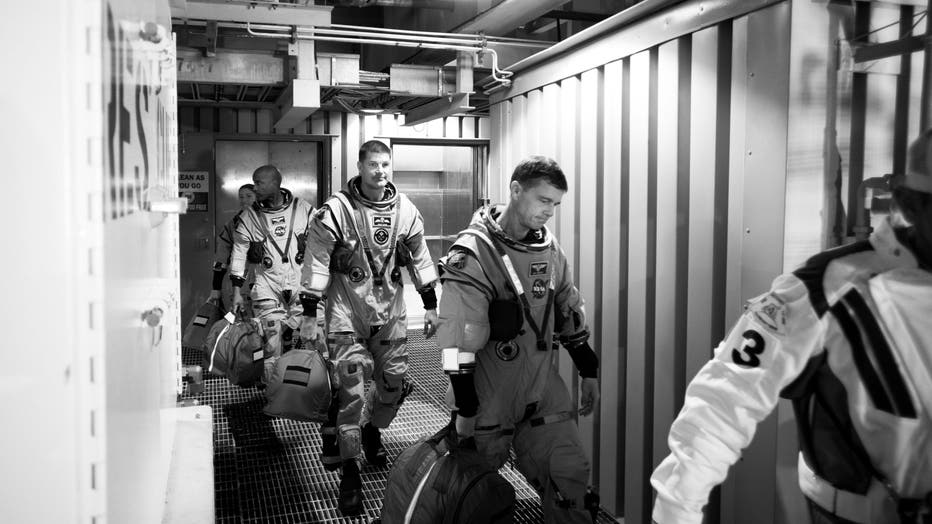
Artemis II crewmembers NASA astronauts Reid Wiseman, commander; Victor Glover, pilot; Christina Koch, mission specialist; and CSA (Canadian Space Agency) astronaut Jeremy Hansen, mission specialist; are led by Bill Owens of the Closeout Crew from the
What we know:
NASA will send four astronauts in the Artemis II for a mission around Earth's moon. The crew will launch from NASA's Kennedy Space Center and will travel aboard the SLS (Space Launch System) rocket and Orion spacecraft.
The astronauts' mission is for scientific discovery, economic benefits, and to build a foundation for the astronauts, NASA said.
The mission will also test Orion's capabilities in deep space, including its critical life support systems.
When is the launch?
The earliest launch window for Artemis II is Feb. 6, 2026, according to NASA.
When asked if NASA was aiming for the beginning or end of its window for a launch date, Charlie Blackwell-Thompson, Artemis II Launch Director, said wet dress – a full-scale practice run – is the driver in that.
Discussing crew safety, John Honeycutt, Artemis Mission Management Team Chair, said, "We're gonna fly when we're ready. From launch to the mission days, the crew's safety is going to be our number one priority."
Here are the other possible launch dates:
- Feb. 7
- Feb. 8
- Feb. 10
- Feb. 11
- March 6
- March 7
- March 8
- March 9
- March 11
- April 1
- April 3
- April 4
- April 5
- April 6
- April 30
What is Artemis II mission?
The crew will travel approximately 4,700 miles beyond the moon’s surface in a 10-day mission.
"Artemis II is a test flight. It truly is exploration," NASA Chief Exploration Scientist Jacob Bleacher said. "There will be a number of first that we'll be proving out on this flight."
"Depending on when the mission launches and when the final path, it's possible they'll see parts of the moon that's never been viewed by human eyes," Bleacher later said.
NASA hosted a press conference with the Artemis II team to discuss the mission's overview. Watch the press conference.
The backstory:
NASA previously conducted a non-crewed mission – using Artemis I in 2022 – by sending an empty Orion capsule to circle the moon after blasting off on NASA’s new Space Launch System (SLS) rocket. Although the launch and lunar laps went well, the capsule returned with an excessively charred and eroded bottom heat shield, damaged from the heat of reentry.
Dig deeper:
Artemis II’s launch has been delayed multiple times. Those delays have pushed the third Artemis mission — a moon landing by two other astronauts — to at least 2027.
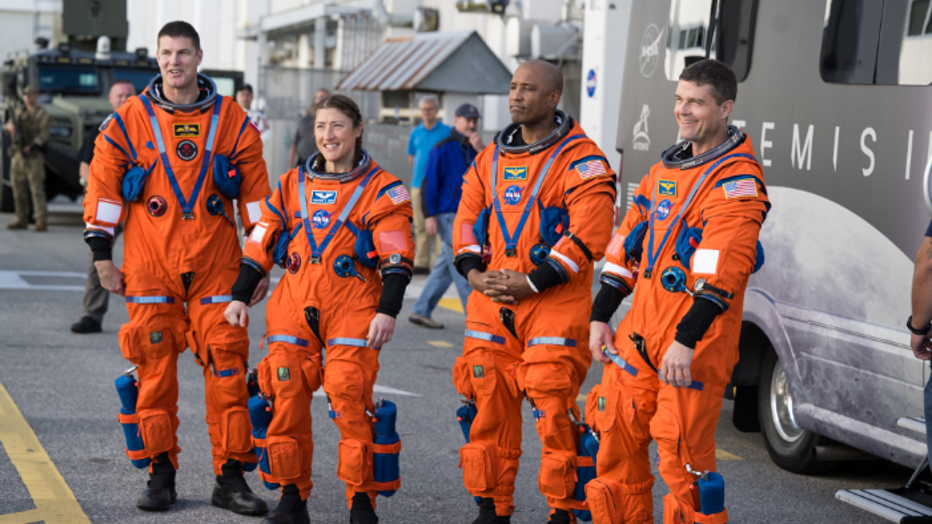
From left to right, CSA (Canadian Space Agency) astronaut Jeremy Hansen and NASA astronauts Christina Koch, Victor Glover, and Reid Wiseman stand outside before boarding their Orion spacecraft inside the Vehicle Assembly Building at NASA’s Kennedy Sp
Who's in the crew?
The Artemis II astronauts are NASA’s Reid Wiseman, Victor Glover, and Christina Koch, and CSA (Canadian Space Agency) astronaut Jeremy Hansen.
"They're all ready to get on the rocket and get on with the mission," Artemis II Lead Flight Director Jeff Radigan said.
What's next:
On Saturday, Jan. 17 at 7 a.m., NASA will conduct a rollout mission – transporting an 11-million-pound stack four miles from the Vehicle Assembly Building to Launch Pad 39B at the Kennedy Space Station. The journey will take up to 12 hours, NASA said.
The team is currently doing its final simulations.
The Source: Information in this story was gathered from the National Aeronautics and Space Administration (NASA).