

Hurricane season guide 2026: What Florida residents need to know
Tracking The Tropics: 2026 Hurricane Season Preview
One storm is all it takes. The FOX 35 Storm Team is getting you ready for the 2026 Atlantic hurricane season. We go beyond the headlines to explain this year’s below-average predictions, the debut of the National Hurricane Center's new inland forecast cone, and the AI technology revolutionizing how we track landfalls. Whether you’re a lifelong Floridian or new to the coast, learn exactly what to expect and how to protect your family, pets, and home. Watch the full special.
ORLANDO, Fla. - June 1 marks the official start to the 2026 Atlantic hurricane season.
Whether this is your first hurricane season or you've been through a few, here's what every Florida resident and tourist needs to know, including hurricane season dates, this year's tropical outlooks, storm names, and emergency preps.
When is hurricane season?
The Atlantic hurricane season runs every year for six months, June 1 - November 30.
The most active months are typically between August, September, and October. The Atlantic season actually has two peaks: mid-September and mid-October, though activity tends to drop quickly after the second peak.
Tropical outlooks
Both Colorado State University and the U.S. National Oceanic and Atmospheric Administration (NOAA) have predicted below-average seasons for the 2026 Atlantic hurricane season.
Why?
An El Niño is expected to develop and strengthen during the summer and fall. El Niño typically brings stronger wind shear across the Atlantic that can rip apart developing tropical systems. While Atlantic waters are slightly warmer than normal (which favors storms) the El Niño effect is forecast to dominate.
Hurricane season predictions
By the numbers:
Colorado State University
- 13 named storms
- 6 hurricanes
- 2 major hurricanes (Category 3 or higher)
NOAA
- 8-14 named storms
- 3-6 hurricanes
- 1-3 major hurricanes (Category 3 or higher)
Average hurricane season
- 14 named storms
- 7 hurricanes
- 3 major hurricanes (Category 3 or higher)
New forecast cone: Here's what to know
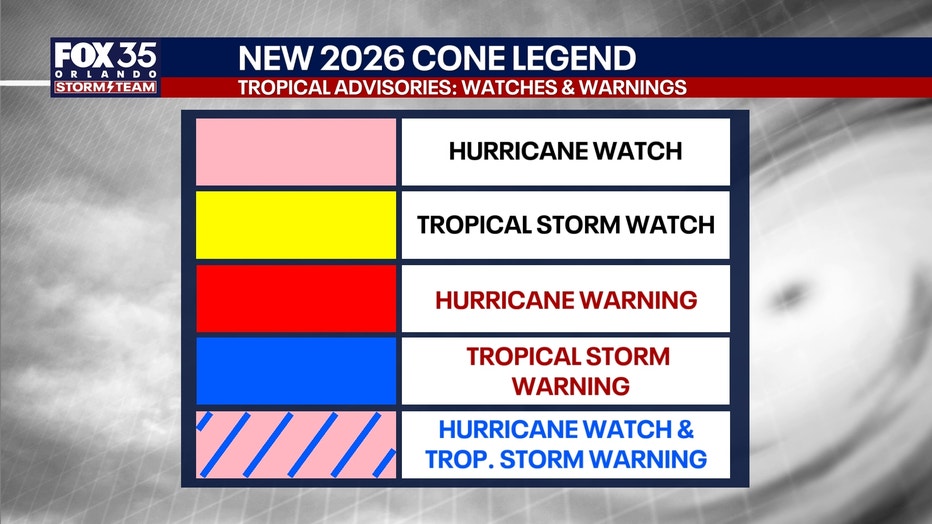
For the 2026 season, the National Hurricane Center said its forecast cone would now include:
- Tropical Storm watches and warnings (yellow for watch, blue for warning)
- Hurricane watches and warnings (pink for watch, red for warning)
- Adds diagonal blue/pink lines to indicate areas under a tropical storm warning and a hurricane watch
- Uses single shading for the 5-day outlook
2026 hurricane storm names
Here are the storm names for the 2026 Atlantic hurricane season:
- Arthur
- Bertha
- Cristobal
- Dolly
- Edouard
- Fay
- Gonzalo
- Hanna
- Isaias
- Josephine
- Kyle
- Leah
- Marco
- Nana
- Omar
- Paulette
- Rene
- Sally
- Teddy
- Vicky
- Wilfred
If all 21 names are used in a season, there is a reserve list with an additional 21 names.
Daily Tropical Outlooks
These tropical outlooks from the National Hurricane Center indicate potential tropical zones, areas of low pressure, depressions, or tropical waves that the NHC is monitoring in the Atlantic Ocean, Caribbean Sea, and Gulf for potential tropical development (ie: tropical storm, hurricane).
The NHC then determines how likely that disturbance could develop: low, medium, or high.
When a system becomes a tropical storm or hurricane, the NHC then issues a forecast zone, which shows the potential track and strength of that system.
The daily tropical outlooks are updated four times a day on the National Hurricane Center's website and social media accounts:
- 2 a.m.
- 8 a.m.
- 2 p.m.
- 8 p.m.
When needed, the NHC will issue a "special tropical outlook" between those times with updates on a potential disturbance's development, direction, or intensity.
How to prepare: Emergency kit
Do you have your emergency kit ready for hurricane season?
Emergency officials recommend preparing for hurricane season before the season starts, including tackling house projects and cleaning up the yard, building an emergency kit should you need to evacuate, ride out the storm, or have no power for several days.
Do you live in a flood zone? Find out here.
If you live in a low-lying area that's prone to flooding, in a mobile home, or an unsafe structure, those areas may be ordered to evacuate during a hurricane, either part of a voluntary evacuation or a mandatory evacuation.
To find out whether you live in a flood zone:
- Visit www.floridadisaster.org/knowyourzone and click the "Know Your Zone map" link.
- Type in your address.
- It will then let you know if you're in a flood zone, and if you are, what zone.
Those who live in Zone A are considered to be the most vulnerable and are typically the first to be evacuated. Zones E & F is the least likely to be evacuated.
The main zones are A, B, C, D, and E. However, some counties have zones specific to them. There are a total of 21 flood zones in Florida.
Click here to find the evacuation zone and route for your specific county.
Emergency Management Offices: County by County Guide
Make sure to follow your specific county's Office of Emergency Management for the latest emergency updates, such as voluntary or mandatory evacuation orders, sand bag information, shelter information, etc.
- Alachua County
- Brevard County
- Dixie County
- Gilchrist County
- Flagler County
- Lake County
- Levy County
- Marion County
- Orange County
- Osceola County
- Polk County
- Seminole County
- Sumter County
- Volusia County
Do Florida's theme parks close for hurricanes?
Walt Disney World, Universal Orlando, SeaWorld, Legoland Florida, SeaWorld, and Busch Gardens each have their own policies when it comes to tropical storms and hurricanes.
As with all policies, there is fine print with specific eligibility and restrictions.
Walt Disney World
If the National Hurricane Center issues a hurricane warning for the Orlando area (or your hometown) within 7 days of your arrival date, Disney does allow people to reschedule or cancel their Disney-booked hotels and vacation packages. Changes can be made online or by calling WDW at 407-939-7675. Click here for more information.
Flights, non-Disney hotels, car rentals, and other services booked through a third party, will need to be discussed with those companies.
Universal Orlando Resort
If a tropical storm, hurricane warning, or state of emergency is declared for the Orlando area (or your hometown) within 7 days of your scheduled arrival, Universal does allow you to reschedule or cancel your Universal-booked hotels or vacation packages. You can contact Universal at 877-801-9720. Click here for more information.
SeaWorld Orlando and Busch Gardens Tampa Bay
Both SeaWorld and Busch Gardens have a "Weather or Not Assurance Policy." If bad weather forces rides to close for over an hour, impacts the theme parks' operating hours or forces the theme park to close or close early, stop by Guest Services to request a return visit. Click here for more information.
Legoland Florida
If the National Hurricane Center issues a tropical storm or hurricane warning within 7 days of your scheduled arrival (or your hometown), you can reschedule or cancel your Legoland Florida Resort visit. You can contact Merlin Entertainments Customer Service at 1-888-690-5346. Click here for details.
The Source: The information used in this article is from several sources, including Colorado State University, National Hurricane Center, NOAA, FOX 35 Storm Team, FloridaDisaster.org, Ready.gov, the FEMA Flood Map Service Center, and county emergency management offices.