

Challenger disaster at 40: How a shuttle explosion changed NASA forever
ORLANDO, Fla. - Forty years after the space shuttle Challenger disintegrated shortly after liftoff, the disaster remains one of the most consequential tragedies in U.S. spaceflight history.
The loss of all seven crew members reshaped NASA’s culture, engineering standards and approach to safety.
Challenger launch drew broad interest
The backstory:
The Challenger mission, designated STS-51L, was intended to deploy a communications satellite and conduct observations of Halley’s Comet. The launch had been delayed several times, and engineers had raised concerns about freezing overnight temperatures that dropped into the low 20s at the launch site.
The crew consisted of Commander Francis "Dick" Scobee, pilot Michael Smith, mission specialists Ellison Onizuka, Judith Resnik and Ronald McNair, payload specialist Gregory Jarvis, and teacher Christa McAuliffe.
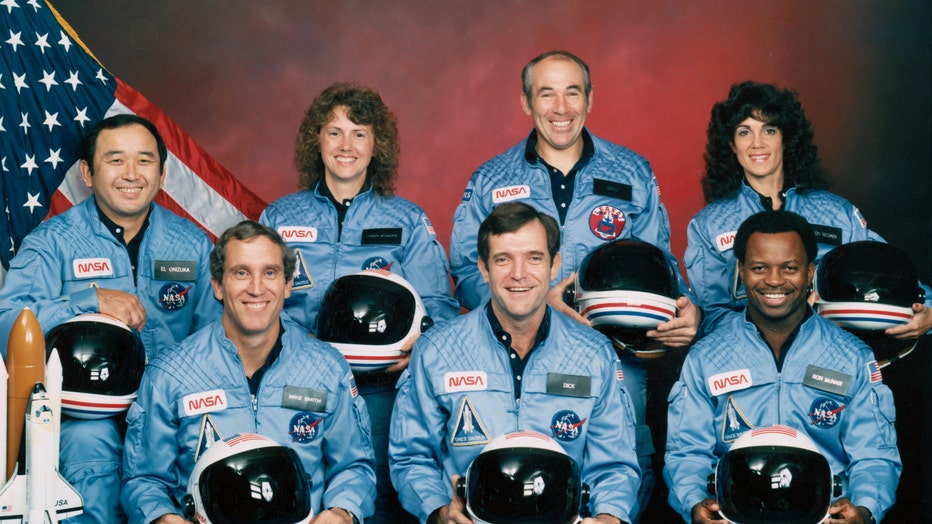
(Original Caption) Five astronauts and two payload specialists make up the STS 51-L crew, scheduled to fly aboard the Space Shuttle Challenger in January of 1986. Crewmembers are (left to right, front row) astronauts Michael J. Smith, Francis R. (Dic
McAuliffe, a New Hampshire teacher, was selected from more than 11,000 applicants to participate in NASA’s Teacher in Space program. She was expected to conduct lessons from orbit and later tour the country promoting science education.
What happened to Challenger and its crew?
What we know:
Challenger lifted off from Kennedy Space Center on Jan. 28, 1986, at 11:38 a.m., under clear skies but unusually cold conditions.
NASA determined that Challenger broke apart 73 seconds after launching. The shuttle was traveling at supersonic speed when structural failure caused the vehicle to disintegrate over the Atlantic Ocean.
As the shuttle passed through a period of maximum aerodynamic stress, a failure in the right solid rocket booster allowed hot gases to escape. Seconds later, a flame breached the external fuel tank, triggering a catastrophic explosion.
What we don't know:
NASA later determined the crew compartment remained largely intact for more than two minutes after breakup before striking the ocean at an estimated 207 mph.
Officials said it could not be conclusively determined whether the astronauts lost consciousness immediately, though evidence suggested some crew members may have survived the initial breakup briefly before impact.
'Truly a national loss’
What they're saying:
Shuttle launches had become a routine occurrence for NASA and over time they drew smaller audiences.
CLICK TO DOWNLOAD THE FOX LOCAL APP
However, this launch was unique because of teacher Christa McAuliffe's participation, which brought unprecedented public attention to the mission, with millions of students across the country watching the launch live.
The major news networks had covered the event for the entirety of the day, with President Ronald Reagan delivering remarks at 5 p.m. from the Oval Office at the White House. The address was broadcast live on nationwide radio and television.
"Today is a day for mourning and remembering," the president said. "We know we share this pain with all of the people of our country. This is truly a national loss."
What caused the explosion?
Dig deeper:
A presidential commission led by former Secretary of State William Rogers concluded that NASA, its Marshall Space Flight Center and contractor Morton Thiokol shared responsibility for the disaster. Engineers had raised concerns about launching in cold weather and warned of O-ring failure, including the night before the launch.
SIGN-UP FOR FOX 35'S BREAKING NEWS, DAILY NEWS NEWSLETTERS
The commission cited flawed decision-making, management pressure to maintain launch schedules, and a failure to adequately address known safety risks. The report identified what later became known as "normalization of deviance," in which repeated technical anomalies were gradually accepted as tolerable.
What did NASA learn from Challenger?
Big picture view:
In response, NASA grounded the shuttle fleet for nearly three years, redesigned the solid rocket boosters, reorganized management structures and created new safety oversight panels. Astronauts were also placed in senior management roles to strengthen safety advocacy.
The Challenger disaster remains a defining lesson in engineering ethics and organizational responsibility — a reminder, NASA officials have said, of the consequences of ignoring warning signs in the pursuit of progress.
The Source: This story was written based on information shared by NASA and the Ronald Reagan Presidential Library and Museum.