

Titusville street flooding: City using permeable pavement, stormwater management to help reduce risks
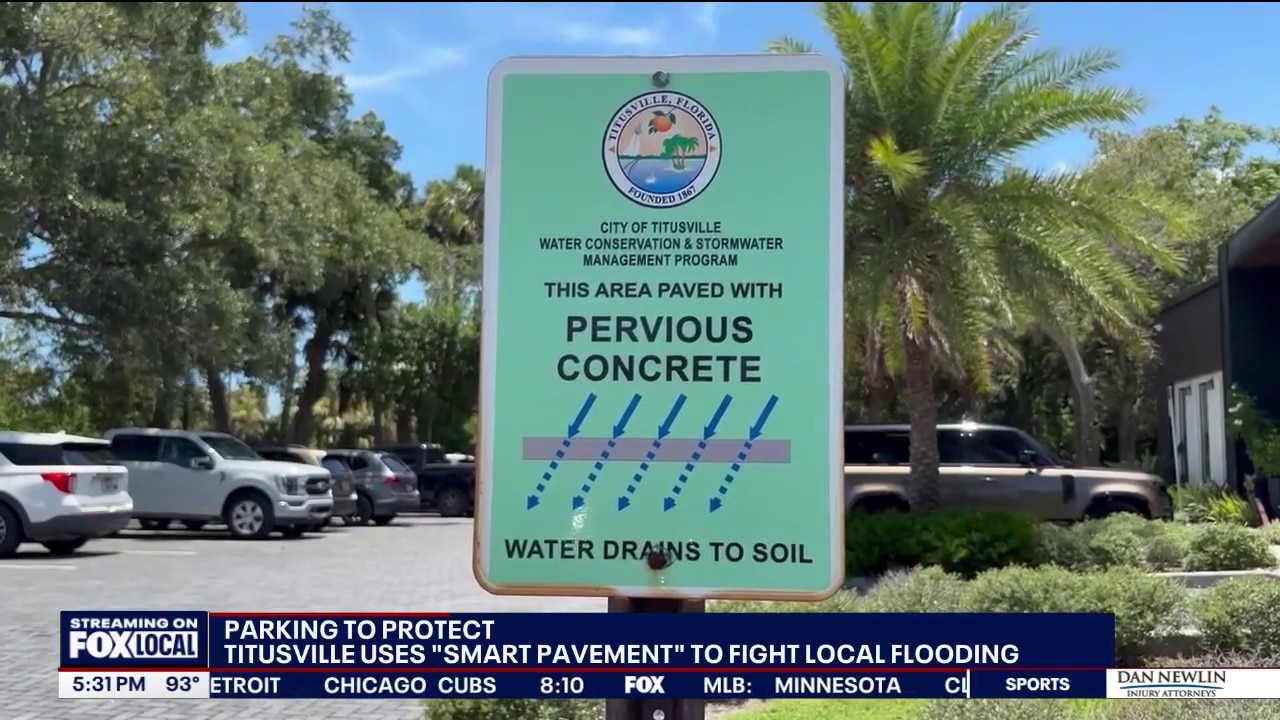
How pervious concrete could help prevent flooding concerns
The City of Titusville is fighting minor flooding and ponding with some new technology -- pervious concrete, sometimes called smart pavement. The mixture allows water to pass through it and into the soil rather than pooling on top and then washing away. FOX 35's Esther Bower talked with city leaders about how and where the new technology is being used.
TITUSVILLE, Fla. - The City of Titusville is taking a new approach to tackling severe street flooding.
The city is turning to innovative paving materials and sustainable design practices to keep rainwater off the streets and out of neighborhoods.
What is permeable pavement?
Local perspective:
The city is encouraging the use of pervious pavement (also known as permeable pavement)—a specialized surface material that allows water to pass directly through it rather than pooling on top.
Unlike traditional concrete or asphalt, which creates a solid barrier, where water gathers and rushes down the street, pervious pavement has a rougher texture that looks similar to tightly packed pebbles.
This infrastructure is part of a broader push toward Low Impact Development (LID)—an approach to land development and stormwater management that mimics natural water cycles to protect local water quality and reduce flood risks.
How does it work?
Dig deeper:
Unlike conventional pavement that forces heavy rain into storm drains and onto roadways, pervious pavement acts as a porous filter layer over crushed stone and gravel.
At local spots like Scobie Park and a commercial parking lot near Pinedo Drive and U.S. 1, rain falls directly onto the surface and absorbs quickly into underlying stone sub-layers before going to plants and rain gardens nearby.
Instead of just serving as a place to park vehicles, these specialized lots double as temporary holding tanks for stormwater during intense downpours.
CLICK TO DOWNLOAD THE FOX LOCAL APP
"It’s holding the water from channeling down the road," said Lily Galleo the Sustainability Program Coordinator for the City of Titusville.
"This property doesn’t contribute to the peak flow rate of the stormwater causing flooding at any other nearby area."
By channeling water underground, the system feeds moisture directly to surrounding natural vegetation, rain gardens and vegetated swales rather than overburdening city storm systems.
What does it do?
City leaders view pervious pavement and LID projects as an essential tool for long-term flood relief.
By keeping water where it falls, these developments prevent localized flooding in surrounding neighborhoods and business corridors. However, city officials emphasize that sustainable paving is part of a larger, multi-pronged effort.
"The pervious pavement isn’t a full solution of our flooding problems here in the city, but it is a step in the right direction," said Kurtis Korwan who’s the Public Information Officer for the City of Titusville.
By moving water back into the ground naturally, the city aims to ensure rainwater settles where it belongs—underground—rather than pooling on roads or creeping into homes.
How can private developers help fight flooding?
Since adopting Low Impact Development practices into its land development regulations in 2021, Titusville has leaned heavily on public-private collaboration.
To encourage participation, the city offers incentives to developers who incorporate permeable pavers, rain gardens and Florida-friendly landscaping.
SIGN-UP FOR FOX 35'S BREAKING NEWS, DAILY NEWS NEWSLETTERS
Last year, roughly 40% of new developments in Titusville incorporated LID projects.
"We’re working on strategies to improve that," said Galleo.
Currently, six new developments actively focusing on LID concepts are underway across Titusville. City officials hope to see these green infrastructure strategies expand into older, flood-prone neighborhoods in the coming years.
"The more developments that can actually implement this, we’ll see more improvements throughout the city," Korwan said.
The Source: FOX 35 Reporter Esther Bower saw a photo of the flooding fix sign on social media and reached out to the city for more information. She met with city officials on July 22, 2026.