

Speeding costs US drivers $22M, saves less than a minute, study finds
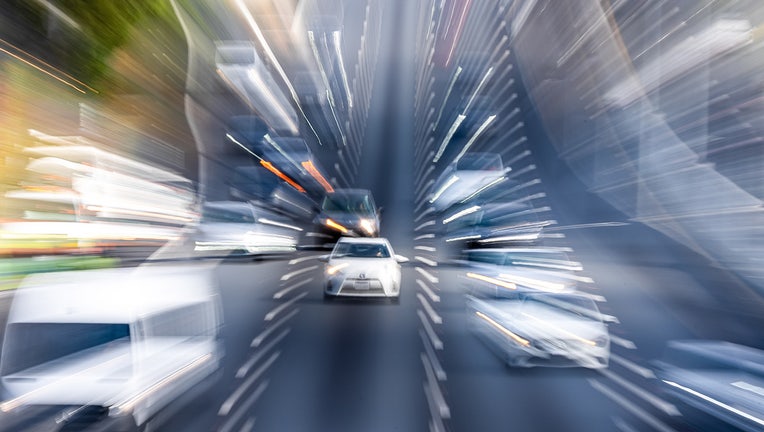
Travelers Ahead Of Independence Day HolidayTraffic on westbound Interstate 80 in Richmond, California, US, on Thursday, July 2, 2026. (Photographer: David Paul Morris/Bloomberg via Getty Images)
A lead foot takes an extra toll on the pocketbook without saving much time, a new study finds. In it, researchers show that the costs of going over the posted speed limits do not appear to outweigh the time saved by speeding.
Why you should care:
Researchers explained their study shows the simple step that drivers can take to save a little at the pump: obey the posted speed limit. They claimed the paper, which was published in the peer-reviewed journal Communications Sustainability, also proved that doing so does not mean drivers will arrive at their destinations that much later.
"Driving fast is easier than ever"
What they're saying:
"Driving fast is easier than ever," University of Minnesota mechanical engineering professor and corresponding author on the paper William Northrop said. "Our study examines an obvious yet difficult-to-implement intervention for major fuel savings that can be achieved without replacing our cars: driving slower."
RELATED: Fiat launches tiny EV in US with shockingly low price tag – and one major catch
Less than a minute saved
By the numbers:
American drivers could save $22 million and 6.7 million gallons of gas if they just followed the posted speed limit, the study’s authors argued. Those extra tens of millions of dollars and millions of gallons of gas are not saving much time either. In the end, researchers estimate drivers are shaving less than a minute off their commute.
The environmental impact
Beyond the impact on the drivers’ pocketbooks, the extra exhaust produced by going faster could be heating up the environment faster as well. The paper contends that going slower could save 57,000 metric tons of carbon dioxide every day.
RELATED: Solar energy passes coal power on list of largest U.S. electricity sources for first time
The backstory:
A University of Minnesota statement on the paper pointed out that many previous studies used localized, small-scale samples or general fuel economy assumptions that used laboratory test results, and the university described the researchers’ work as a "major milestone in transportation science."
The authors of this latest study, the statement explained, examined 120 million real-world trips in the United States. Researchers took all that data and took into account U.S. road networks, speed limits, and elevation to create their models.
What's next:
Despite all that data, the authors acknowledge that more work was needed to fully understand the effects on fuel and emissions. They are already planning the next phases of their research, which will use an instrumented electric vehicle with multi-sensor systems that can track driver behavior more closely and in real time.
RELATED: Average new car payment reaches all-time high as affordability issues persist
"Key remaining challenges of our research are to expand our framework to more diverse roadways and understand the impacts of aggressive accelerations on fuel use and emissions," added Northrop. "Exploring both speed and acceleration reductions will give us an even more complete picture of real-world fuel savings potential."
The Source: Information for this article was taken from the University of Minnesota. This story was reported from Orlando.