

Rare sighting: Harbor seal spotted on sandbar in Florida's Mosquito Lagoon
PONCE INLET, Fla. - A Harbor seal was seen stranded on a Florida sandbar – a sighting the Hubbs SeaWorld institute is calling "extremely rare."
The seal was spotted on a sandbar in the Mosquito Lagoon, about five miles south of Ponce Inlet on Monday, the Hubbs-SeaWorld Research Institute confirmed Thursday.
What we know:
A team with the Hubbs-SeaWorld Research Institute responded to a report of a seal stranded on a sandbar in the Mosquito Lagoon, located in Volusia and Brevard counties.
The seal was spotted about five miles from Ponce Inlet.
Brevard County is known to be a "hot spot" for having more than twice the number of stranding than any other county in Florida from 1977 to 2020, the research institute said.
The team evaluated the Harbor seal's condition and took photos before the seal re-entered the water, the research institute told FOX 35. The Marine Discovery Center also confirmed this sighting.
The seal wasn't seen again after re-entering the water.
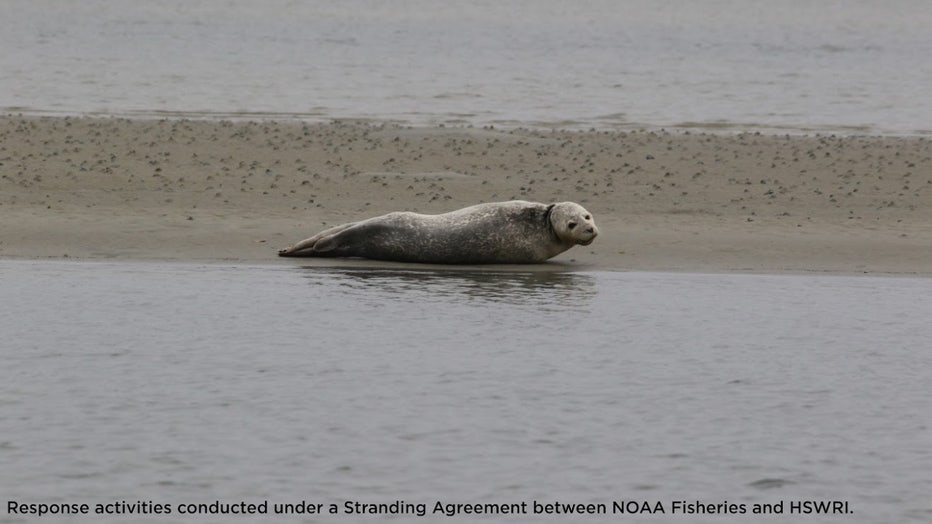
A Harbor seal was seen on a sandbar, about five miles from Ponce Inlet on March 9. (Source: Hubbs-SeaWorld Research Institute (HSWRI))
What is a Harbor seal?
Harbor seals – a common marine animal native to the northern coasts of North America, Europe and Asia – are considered non-migratory.
The National Oceanic and Atmospheric Administration (NOAA) identified 18 stocks of Harbor seals along the United States' east and west coasts in Alaska, California and Oregon-Washington coasts.
Hubbs-SeaWorld said the seals rarely travel south of North Carolina – calling Monday's sighting, "extremely rare."
"Harbor seal strandings in Florida are extremely rare. In fact, there have been only two in the last 20 years," the research institute said.
As part of the seal family, Harbor seals have similar features such as: short forelimbs, also known as flippers, have short dog-like snouts, ear holes and have light tan, silver or blue-gray coloring with dark spots. Some Harbor seals can weigh up to 285 pounds – with males being slightly larger.
See a stranded seal? Here's what do to
What you can do:
Though these sightings are rare in Florida, Hubbs-SeaWorld said to report the stranding right away.
Here's four ways you can help:
- In Florida, report a stranding by calling: 1-888-404-3922
- Stay at least 300 feet away and keep dogs on a leash. If the seal, or any other stranded animal, reacts to your presence, you're too close, the institute said.
- Don't touch, pick up or attempt to feed the seal.
- If possible, take a photo or video to help first responders confirm the sighting and to assess the animal's condition.
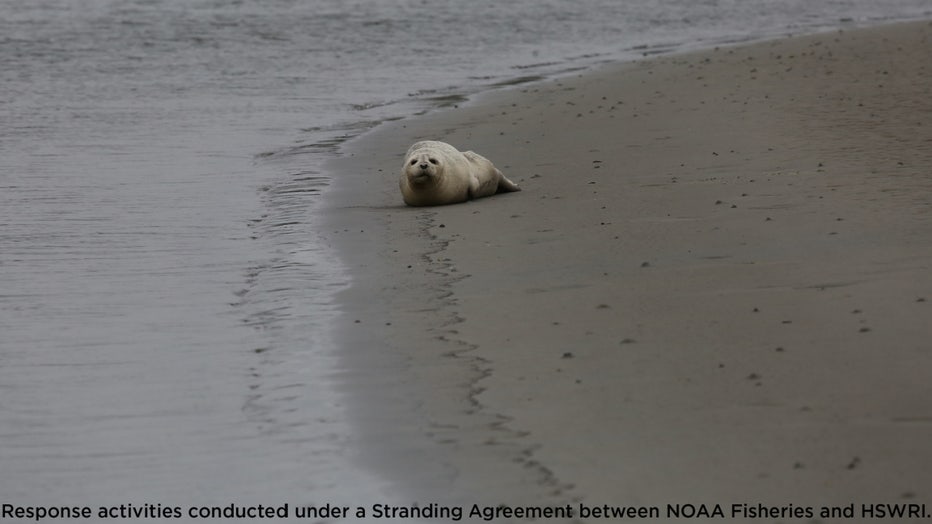
A Harbor seal was seen on a sandbar, about five miles from Ponce Inlet on March 9. (Source: Hubbs-SeaWorld Research Institute (HSWRI))
Protected marine animals
Harbor seals are among marine animals that are a protected species under the Marine Mammal Protection Act.
"It is against the law to feed or harass them, which includes any action that might disturb their behavior," the institute said.
Who is the Hubbs-SeaWorld Research Institute?
The Hubbs-SeaWorld Research Institute – a non-profit scientific research organization – was founded in 1963 to conduct marine life and oceanic research.
The institute has been a member of NOAA Fisheries' Marine Mammal Health and Stranding Response Program since 1997 – providing emergency stranding response for 40% of Florida’s east coast, including 1,100 square miles of estuarine waters.
The Source: Information in this story was gathered from the Hubbs-SeaWorld Research Institute.