

New Report: Almost half of the junk in space is ‘uncontrollable’, causing concern for people and payloads
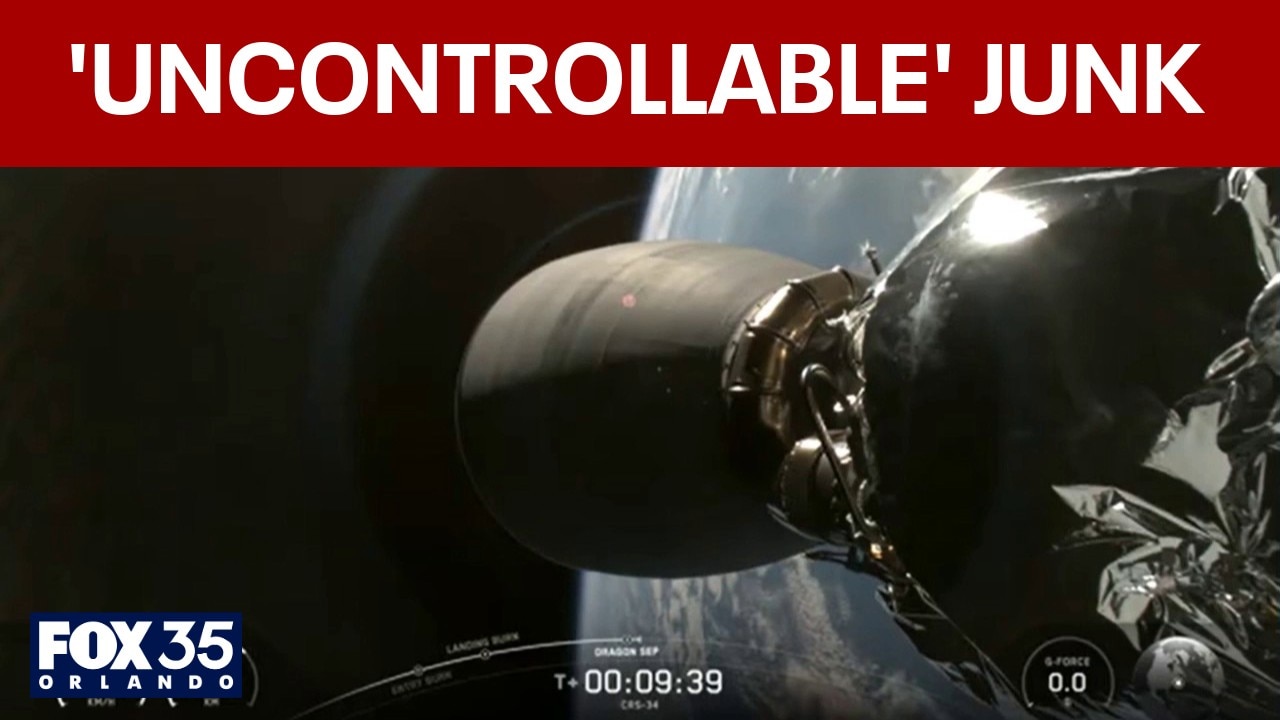
'Uncontrollable' space junk: Thousands of debris floating in space
According to the newly released Space Debris Report by Accu, nearly half of the objects currently tracked in Earth's orbit are considered completely uncontrolled space junk. The Accu Orbital Tracking Report currently monitors 33,269 objects in Earth's orbit. Of those, only 17,682 are classified as functioning payloads (satellites). The rest consists of rocket bodies, unassigned objects, and thousands of pieces of debris.
BREVARD COUNTY, Fla. - Rocket launches on the Space Coast are happening more often, but a major hazard is quietly brewing right above our heads.
Space experts say orbital trash is one of the biggest crises the aerospace industry faces today.
Not enough space in Space?
What we know:
According to the newly released Space Debris Report by Accu, nearly half of the objects currently tracked in Earth's orbit are considered completely uncontrolled space junk.
When space exploration began, the cosmos was treated as an infinite, empty frontier. Decades later, the paradigm has shifted.
"Wanting to clean it up is definitely going to be a big thing," said Zac Aubert, founder of The Launch Pad Network. "As we get more and more stuff in space, you’re going to basically have these narrow corridors you can launch through to actually get to depending on which orbit you are going to."
The Accu Orbital Tracking Report currently monitors 33,269 objects in Earth's orbit. Of those, only 17,682 are classified as functioning payloads (satellites).
The rest consists of rocket bodies, unassigned objects, and thousands of pieces of debris. This means roughly 47% of all tracked orbital objects are space junk—essentially translating to seven pieces of floating trash for every ten working satellites.
Because almost half of this junk is completely unpropelled and uncontrollable, scientists have no way of knowing exactly when, where, or what it might hit.
Small pieces, big problems
While tracking massive, dead satellites is difficult enough, the real nightmare involves the objects we cannot see.
"It’s hard to track a screw or, like you say, a tiny little fleck of paint," said Don Platt, Director of the Spaceport Education Center at Florida Tech. "Keep in mind, they’re moving at miles per second."
Objects in low Earth orbit travel at blistering speeds of roughly 28,000 km/h (over 18,000 mph). At that extreme velocity, the laws of physics turn microscopic particles into weapons of mass destruction. Experts note that a rogue fleck of paint holds enough kinetic energy to completely shatter spacecraft windows, while a tiny debris fragment measuring just one centimeter can completely disable an active spacecraft.
According to NASA estimates cited in the report, while we track around 33,000 large items, there are an estimated 900,000 fragments between 1 and 10 centimeters, and more than 128 million microscopic particles swirling untracked. A single collision can trigger a chain reaction known as the "Kessler Syndrome," where colliding debris creates thousands of new fragments, eventually rendering entire orbital zones completely unusable.
Dealing with debris
How do we rid the skies of dangerous, invisible junk? It’s the million-dollar question, and the aerospace industry is scrambling for solutions.
"There are dozens of companies making 'Hungry Hungry Hippos,' big nets," Aubert explained.
Garbage trucks in space may sound like something straight out of a science fiction movie, but Active Debris Removal (ADR) technologies are actively being developed. Aerospace innovators are currently engineering automated spacecraft utilizing robotic arms, giant space nets, harpoons, magnetic capture systems, and even specialized lasers designed to safely slow down and de-orbit large debris.
Historically, older satellite missions lacked a plan for what happened after their operational lifespans ended. Today, the tide is turning. Modern aerospace regulations and newer private firms are strictly mandating "de-orbit plans"—ensuring that future payloads are intentionally steered into the atmosphere to burn up harmlessly once they are no longer in use.
The Source: Information in this story was gathered from FOX 35's Esther Bower and a Space Debris Report by Accu.